UK NEWS
UK Government Borrowing Hits £24.5 Billion as National Debt Passes £3 Trillion
LONDON — The United Kingdom’s government borrowed £24.52 billion in September, exceeding official forecasts as rising public spending and debt intere...
By Wavers News
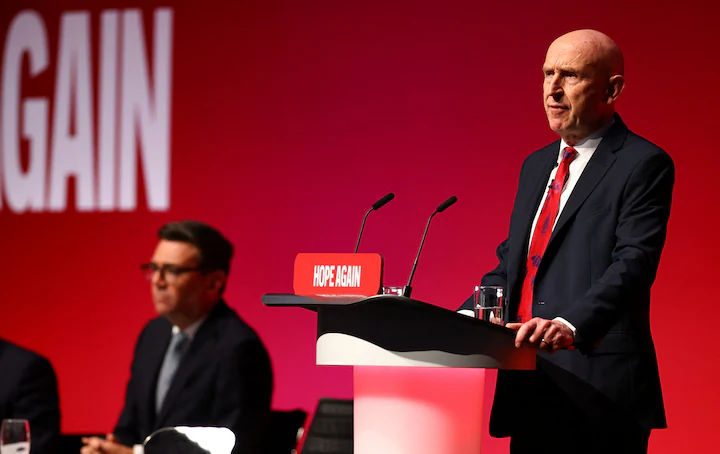
British Finance Minister John Healey addresses delegates at the Labour Party’s annual conference in Liverpool, United Kingdom, on September 28, 2026.
Figures released on Wednesday put September’s borrowing £1.9 billion above the £22.6 billion forecast by the Office for Budget Responsibility (OBR). The amount was also £1.8 billion higher than the £22.8 billion recorded in September last year.
The latest figures present a difficult financial position for the government as it prepares its October 28 budget. Borrowing during the first six months of the 2026/27 financial year has fallen compared with the same period last year, but it remains above the level projected in the government’s earlier fiscal plans.
The data also confirmed that the country’s public sector net debt had passed £3 trillion for the first time, highlighting the scale of the financial obligations facing policymakers.
DEBT INTEREST COSTS ADD TO BORROWING
Higher spending on debt interest was a major factor behind September’s borrowing figures.
The government paid £10.9 billion in central government debt interest during the month, an increase of £1.6 billion compared with September 2025. The amount was also £2 billion above the OBR’s forecast.
Debt interest represents the cost of servicing money the government has borrowed. These payments compete with other demands on public finances, including healthcare, education, infrastructure and social support.
The government’s overall spending increased more quickly than its income in September, contributing to the larger deficit.
Central government receipts reached £90.1 billion, while expenditure totalled £111.3 billion. The difference between these figures reflects the scale of the gap that public borrowing helps finance, although total public sector borrowing also includes local government and public corporations.
September’s borrowing was the second-highest recorded for that month, behind September 2020, when the figures were affected by the coronavirus pandemic.
The latest figures demonstrate the continuing difficulty of controlling borrowing when expenditure rises faster than government revenue.
PUBLIC DEBT EXCEEDS £3 TRILLION
The UK’s public sector net debt was provisionally estimated at £3.005 trillion at the end of September.
The figure represents an increase of £91.7 billion compared with a year earlier. It marks the first time the country’s public sector net debt has exceeded £3 trillion.
Public debt accumulates when government borrowing adds to the amount owed to lenders and other holders of government liabilities.
The increase reflects years of borrowing to finance public spending and respond to economic pressures, including the pandemic and subsequent increases in the cost of living.
Measured against the size of the economy, public sector net debt stood at 94 per cent of gross domestic product (GDP). That proportion was 0.7 percentage points lower than a year earlier.
The distinction matters because the absolute amount of debt does not, by itself, determine how easily a country can manage its financial obligations. Economists also consider the size of the economy, government revenue and the cost of servicing outstanding debt.
Even with the lower debt-to-GDP ratio, the latest figures show that the government continues to face substantial borrowing and debt-servicing demands.
SIX-MONTH BORROWING REMAINS ABOVE FORECAST
Government borrowing reached £97.8 billion between April and September, the first six months of the 2026/27 financial year.
That was £4.4 billion, or 4.3 per cent, below the amount recorded during the same period last year.
The total was also £6 billion above the OBR’s forecast for the period.
The comparison presents a mixed picture for the government. Borrowing has declined year on year, yet the improvement has not been sufficient to bring the total in line with the official forecast.
The six-month figure was equivalent to 3.1 per cent of GDP and was the tenth-highest April-to-September borrowing total since monthly records began in 1993.
The government’s current budget deficit, which measures borrowing used to fund day-to-day public sector activities, reached £64 billion during the same period. That was £5.7 billion lower than a year earlier, but still £2.4 billion above the forecast.
The figures underline the difference between reducing borrowing compared with the previous year and meeting the government’s planned financial targets.
OCTOBER BUDGET EXPECTED TO FACE CLOSE SCRUTINY
The government is scheduled to present its budget on Wednesday, October 28, with updated economic and fiscal forecasts expected to accompany the announcement.
The figures released this week provide an important indication of the financial conditions facing policymakers before the budget.
The government must determine how to manage public spending, raise revenue and meet its fiscal rules while accounting for the cost of servicing its existing debt.
Higher borrowing costs in international financial markets have added to the challenge. When investors demand greater returns to lend money to governments, the cost of raising funds can increase, putting further pressure on public finances.
The economic consequences of the conflict involving Iran have also contributed to uncertainty surrounding energy prices, inflation and the broader economic outlook.
There is speculation that the government may consider measures to increase revenue, including changes affecting banks. The final measures will depend on the budget announcement, and proposed changes should not be treated as confirmed policy before they are formally announced.
The government’s room for financial manoeuvre will depend partly on the updated forecasts and the amount of flexibility available under its fiscal rules.
WHAT THE FIGURES MEAN FOR BRITAIN
The latest borrowing data highlight the financial pressures facing the UK government as it prepares its next budget.
Although borrowing during the first half of the financial year is lower than it was a year earlier, the amount remains above the official forecast. At the same time, rising debt interest payments are absorbing billions of pounds that could otherwise be available for other government priorities.
The figures do not, on their own, establish whether the country is heading towards a financial crisis. They do show that managing the national debt and meeting spending commitments remain significant challenges.
The upcoming budget will provide further details about the government’s plans for taxation, spending and borrowing.
With public debt now above £3 trillion, the decisions announced next week will be closely watched by investors, businesses and households seeking clarity on the country’s economic direction.