International
US Audit Finds $85m in F-35 Fighter Jet Parts Still Unaccounted for as Morocco Explores Possible Acquisition
A new US government audit has exposed continuing weaknesses in the Pentagon's management of spare parts for the F-35 stealth fighter, revealing that o...
By Wavers News
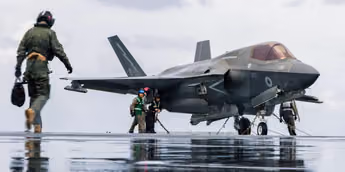
An F-35B stealth fighter jet on an aircraft carrier as Morocco reportedly seeks US approval to train its pilots on the F-35A variant ahead of a potential acquisition. (Image credit: Assahifa Arabic)
The findings, published on November 9, 2026, by the Government Accountability Office (GAO), also raise concerns about the Pentagon's ability to track billions of dollars in aircraft components distributed across hundreds of military and contractor facilities worldwide.
The F-35 programme, developed by American defence manufacturer Lockheed Martin, relies on a global supply network containing approximately 26 million parts valued at about $31 billion.
Despite the scale of the programme, the audit found that the Department of Defense (DoD) does not maintain complete and reliable records of the components under its ownership. Some records are outdated, inaccurate or incomplete, making it difficult for officials to establish the location and status of equipment needed to maintain the aircraft.
The findings come as Morocco attracts attention over reports that it is exploring the possibility of acquiring the F-35A, potentially becoming the first African country to operate the American fifth-generation fighter.
MORE THAN ONE MILLION PARTS REPORTED MISSING
The $85 million discrepancy dates back to an earlier investigation published by the GAO in May 2023.
That investigation found that a major F-35 contractor had incurred losses involving more than one million spare parts between May 2018 and October 2022. The components were valued at more than $85 million.
At the time, auditors also discovered that the Pentagon's F-35 Joint Program Office had reviewed fewer than two per cent of the identified losses since 2018.
The latest investigation shows that the problem remains unresolved. As of March 2026, the Joint Program Office could not establish the status of the parts previously identified as missing or determine whether subsequent loss reports covered those same components.
The contractor had submitted approximately $28 million in reports involving lost parts between 2012 and 2025. The Defense Contract Management Agency determined that the contractor should be financially responsible for approximately $6 million.
The programme office was unable to establish whether those reports included the losses identified in the earlier investigation because it had not maintained complete records of outstanding cases.
The audit does not establish that the missing components were stolen. It highlights the failure to maintain adequate records and investigate reported losses.
THOUSANDS OF OTHER COMPONENTS ABSENT FROM INVENTORY RECORDS
Beyond the previously reported losses, the investigation identified another major weakness involving parts undergoing repairs or maintenance.
As of March 2026, more than 17,000 F-35 components valued at approximately $1.3 billion were not properly reflected in the programme's inventory records.
The estimated value could reach $2.5 billion when additional acquisition expenses and missing cost information are taken into account.
These components are not necessarily physically lost. The problem is that the Pentagon's records do not provide a reliable picture of where they are and their current status.
The audit identified weaknesses in the systems used to exchange information between the government and major contractors, including Lockheed Martin and Pratt & Whitney, the company responsible for supplying the F-35's engines.
The Pentagon relies on an inventory management platform known as the Enterprise Logistics Management System. Although the system is designed to manage information about government-owned aircraft parts, it cannot directly connect with the property management systems operated by the major contractors.
As a result, the Joint Program Office depends on periodic information submitted by contractors instead of receiving continuous updates.
Some information is submitted quarterly, meaning records can become more than three months old before they are updated.
Auditors also identified weaknesses in the quality of information supplied to the government. A December 2025 submission contained serial numbers for only 29 per cent of the parts records, while National Stock Numbers were available for just 43 per cent.
Some entries also recorded component costs at one cent or less, raising concerns about the accuracy of the information.
$17M SPENT ON INVENTORY CHECKS WITHOUT RESOLVING THE PROBLEM
The Pentagon has spent considerable resources attempting to improve its knowledge of the F-35 spare-parts inventory.
Since fiscal year 2020, the Joint Program Office has spent at least $17 million conducting physical inventory exercises.
The latest audit found that these exercises had not adequately confirmed the physical existence of all the parts or established that government records accounted for the complete inventory.
The GAO also identified weaknesses in the training and procedures provided to officials responsible for tracking government-owned property.
According to the watchdog, the programme office has not developed a fully functioning accountability structure with clear responsibilities and adequate guidance for personnel handling the records.
The deficiencies could affect the military's ability to determine which components are available, identify shortages and plan maintenance requirements.
The GAO warned that unreliable inventory information could undermine aircraft readiness and make it more difficult for the Pentagon to produce accurate financial statements.
It recommended four corrective actions, including stronger monitoring of reported losses, improved procedures for property officers, specialised training and clarification of the responsibilities and staffing requirements for those overseeing the programme.
The Department of Defense agreed with all four recommendations and said it was taking steps to address the identified weaknesses.
MOROCCO'S INTEREST IN THE F-35 ATTRACTS ATTENTION
The audit has emerged at a time when Morocco is reportedly exploring the possibility of acquiring the F-35A, the conventional take-off and landing version of the fighter.
A Moroccan publication reported in October that Rabat had requested US assistance in training some of its air force pilots to operate the aircraft. The report, which cited unnamed sources, did not disclose how many pilots were involved or provide an official training timetable.
The reported request has not received public confirmation from either the Moroccan or United States government.
Interest in the aircraft also received attention during the Marrakech International Air Show held from October 7 to 10, 2026. Lockheed Martin participated in the event, displaying an F-35 cockpit demonstrator and a scale model of the aircraft.
Two US Air Force F-35A fighters also took part in an aerial display during the event. Their appearance provided Moroccan audiences with an opportunity to see the aircraft, but did not represent confirmation of a purchase agreement.
Lockheed Martin separately used the exhibition to engage Moroccan companies about opportunities to participate in its international aerospace and defence supply chain.
The company said it wanted to identify local manufacturers capable of supporting current and future programmes, while expanding Morocco's industrial and aircraft maintenance capabilities.
Despite these developments, no signed F-35 purchase contract or official US approval naming Morocco as a customer had been announced at the time of the reports.
A POSSIBLE FIRST FOR AFRICA
If Morocco eventually secures approval and completes an acquisition, it would become the first African operator of the F-35 fighter.
The aircraft is designed with stealth technology, advanced sensors and integrated systems that allow pilots to gather and process information from different sources during military operations.
Its sophisticated capabilities also require extensive maintenance infrastructure, specialised personnel, secure information systems and a dependable supply of spare parts.
Morocco already operates American-made F-16 fighter jets and maintains a longstanding defence relationship with Lockheed Martin. The company has also been involved in efforts to expand the country's aircraft maintenance and aerospace manufacturing capacity.
The GAO findings underline the logistical and financial responsibilities associated with operating an advanced fighter aircraft. Beyond the initial purchase price, countries acquiring the F-35 must maintain access to spare parts, technical support and specialised maintenance throughout the aircraft's service life.
The Pentagon's inventory problems do not establish that the F-35 is unsafe or that its operational capabilities have been compromised. They do, though, expose significant accountability weaknesses in the support system behind one of the world's most expensive military aircraft programmes.
The GAO estimates that the F-35 programme's total lifetime cost exceeds $1.9 trillion, making effective management of its equipment, maintenance and supply chain a major concern for the US military.