Business
Renault Trucks Abandons Plans to Reopen 2,000-Unit Assembly Plant in Algeria After Approval Setback
Renault Trucks has abandoned its efforts to restart operations at its truck assembly plant in Algeria after repeated attempts to secure government app...
By Wavers News
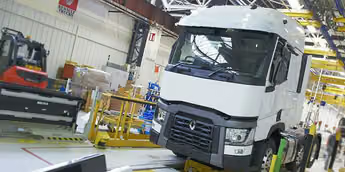
A Renault Trucks T Range heavy-duty truck cabin is fitted onto the production line at the company's assembly plant in Bourg-en-Bresse, France. (Image: Renault Trucks / Volvo Group)
The Swedish-owned heavy vehicle manufacturer's decision concerns its SPA Soprovi Algérie facility in Meftah, Blida Province, which was established to assemble heavy-duty trucks for the Algerian market.
The factory was designed to produce approximately 2,000 trucks annually, but has remained inactive since 2020 following changes to Algeria's vehicle assembly and import regulations.
The latest development ends the company's attempts to obtain authorisation from Algeria's Ministry of Industry to resume production at the facility.
A MAJOR TRUCK ASSEMBLY PROJECT THAT NEVER REACHED ITS FULL POTENTIAL
The Meftah facility was developed through a partnership involving Volvo Group, which owns Renault Trucks, and Algeria's BSF Souakri Group.
Construction began in 2017, with the project intended to strengthen local production of heavy commercial vehicles and reduce Algeria's dependence on imported trucks.
According to Volvo Group's original project announcement, the factory covered approximately 24,000 square metres and was planned in two development stages.
The initial target was to assemble 1,000 vehicles in 2018 before increasing production to 2,000 trucks annually from 2019.
The facility was expected to manufacture heavy-duty Renault Trucks C and K models, which are designed for demanding transport, construction and industrial applications.
The project also promised employment opportunities and the transfer of technical knowledge to Algeria's manufacturing sector.
Volvo Group held a 30 per cent stake in the joint venture, while the Algerian BSF Souakri industrial group owned the remaining 70 per cent.
WHY PRODUCTION STOPPED IN 2020
The factory's operations were suspended in 2020 after the Algerian government discontinued the preferential import arrangements that allowed vehicle assembly companies to bring completely knocked-down and semi-knocked-down kits into the country under special conditions.
These kits contain vehicle components imported for assembly at local facilities rather than importing fully assembled vehicles.
The government introduced the changes as part of efforts to address weaknesses in the country's previous vehicle assembly model, which had faced criticism over limited local manufacturing and excessive dependence on imported components.
Authorities sought to establish a stronger domestic automotive industry supported by local suppliers, industrial investment and higher levels of component production within Algeria.
The policy changes affected several vehicle assembly operations, including Renault Trucks' Meftah facility.
30 PER CENT LOCAL INTEGRATION REQUIREMENT BLOCKED RESTART
Renault Trucks subsequently attempted to obtain fresh approval to resume production but encountered additional regulatory requirements.
In May 2025, Algerian authorities asked the company to revise its proposal and provide guarantees that the factory would achieve a local integration rate of at least 30 per cent within five years of restarting operations.
The requirement was part of Algeria's revised automotive manufacturing framework, which places greater emphasis on sourcing components and production inputs locally.
The condition presented a significant challenge for the manufacturer, as obtaining approval required more than simply reopening the existing assembly line.
Renault Trucks needed to demonstrate how the facility would develop domestic industrial participation and meet the government's expectations for local manufacturing.
Despite the setback, the company continued engaging with Algerian authorities in an attempt to find a way forward.
VOLVO GROUP'S 2026 TALKS FAILED TO SECURE A BREAKTHROUGH
Hopes of a possible restart resurfaced in February 2026 when Volvo Group Executive Vice-President Jens Holtinger met Algeria's Industry Minister, Yahia Bachir, in Algiers.
The meeting, which also involved Sweden's ambassador to Algeria, Anna Block Mazoyer, focused on the group's industrial activities and opportunities to expand local truck production.
Volvo Group expressed its continued interest in supporting Algeria's industrial development through heavy vehicle manufacturing, transport solutions, technical services and stronger local supply chains.
The discussions raised expectations that the Meftah facility could eventually resume operations.
The latest decision by Renault Trucks indicates that those efforts did not produce the necessary approval.
After several unsuccessful attempts, the company has now abandoned its pursuit of authorisation to restart the Soprovi assembly plant.
A SETBACK FOR ALGERIA'S AUTOMOTIVE MANUFACTURING AMBITIONS
The development comes as Algeria attempts to attract international automotive manufacturers while demanding greater domestic participation in vehicle production.
The country has been working to establish a more sustainable automotive industry after previous assembly initiatives struggled to meet local manufacturing expectations.
Its revised industrial approach requires companies seeking to assemble vehicles to demonstrate meaningful commitments to local production, supplier development and investment.
The Renault Trucks situation highlights the difficulties international manufacturers can face when existing assembly arrangements do not satisfy updated industrial requirements.
The closure of the Meftah facility also represents a missed opportunity to develop local capabilities in heavy vehicle manufacturing, particularly at a time when Algeria needs reliable trucks for transportation, construction, mining, agriculture and other economic activities.
The country continues to depend heavily on road transportation for moving goods, making access to modern heavy-duty vehicles important for businesses and industrial operators.
Volvo Group held discussions with Algerian officials earlier in 2026 about expanding its industrial presence, Renault Trucks' decision means the planned restart of its 2,000-unit assembly operation will not proceed under the current authorisation process.
The development concerns the Meftah assembly project and should not be interpreted as confirmation that Volvo Group is withdrawing all its activities or commercial interests from Algeria.