International
Canada Could Turn to Chinese Automakers if Trade Negotiations With Trump Fail, Carney Says
Canadian Prime Minister Mark Carney has warned that Canada could pursue partnerships with Chinese, European or Japanese automakers if ongoing trade ne...
By Wavers News
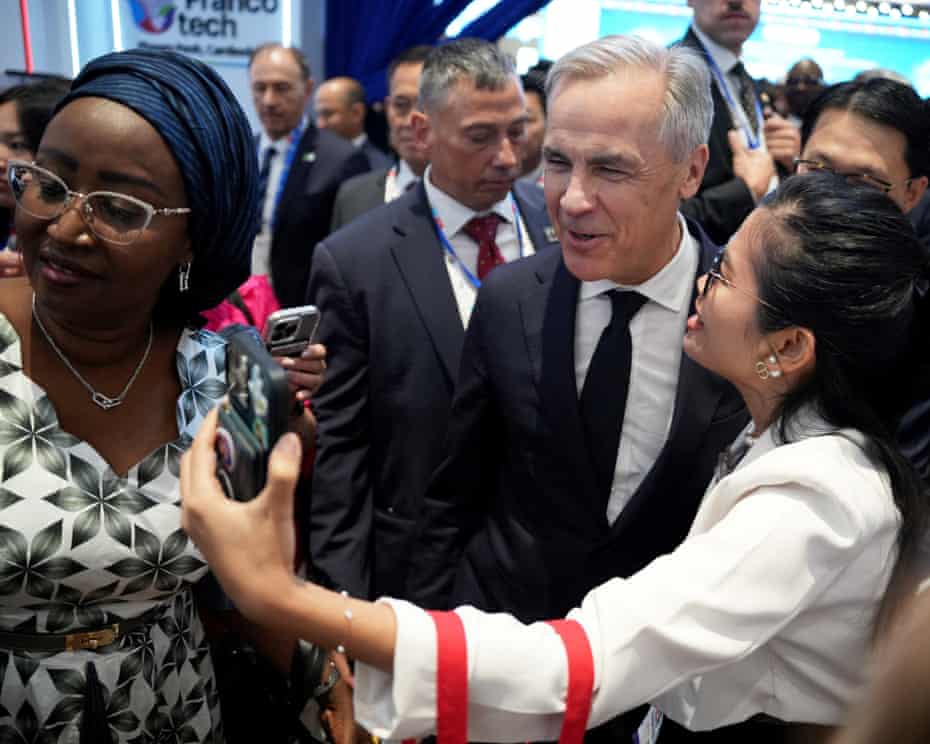
Canada’s prime minister, Mark Carney, is photographed with attendees during the 20th Francophonie summit in Phnom Penh, Cambodia, on the weekend. Photograph: Soveit Yarn/Reuters
Carney made the remarks on Monday, November 16, while speaking to journalists in Phnom Penh, Cambodia, ahead of a planned meeting with Chinese President Xi Jinping in Shenzhen later this week.
The discussions with Washington remain his government's priority, but Carney indicated that Canada would consider alternative investment opportunities if the United States continues to undermine the integrated manufacturing system that has connected the two countries for decades.
His comments come as President Donald Trump's trade policies and tariffs place increasing pressure on Canada's automotive sector, which depends heavily on cross-border manufacturing and supply chains.
CARNEY INSISTS CANADIAN AUTOMOTIVE INDUSTRY MUST BE PROTECTED
Carney said Canada wanted to maintain an integrated North American automotive market that allows workers and manufacturing facilities across the region to operate at full capacity.
He argued that recent American trade actions had weakened the relationship between the two countries' automotive industries, making it necessary for Canada to consider other opportunities.
The Canadian prime minister stressed that any agreement reached with Washington must leave the country with a viable automotive industry.
He also dismissed suggestions that the possibility of Chinese investment was simply a negotiating tactic against the Trump administration.
Carney said Canada would pursue other opportunities if its automotive workers and manufacturing facilities could not operate fully within the North American market.
He maintained that the country would continue developing its economy regardless of the outcome of negotiations with the United States.
CHINESE INVESTMENT MUST INCLUDE ACTUAL MANUFACTURING
Canada is considering possible partnerships with Chinese automakers, Carney made clear that his government would not accept investment arrangements based solely on importing vehicles or assembling foreign-made components.
He said any investment would need to establish substantial manufacturing operations within Canada, supported by appropriate labour standards, production facilities and domestic supply chains.
The proposed arrangement would also involve Canadian critical minerals used in electric vehicle production, creating opportunities for local industries to participate in the manufacturing process.
Carney emphasised that the objective was to create genuine industrial activity and employment rather than simply provide a market for imported vehicles.
The approach suggests that Canada wants foreign automotive investment to strengthen its domestic manufacturing capacity and provide long-term economic benefits.
CANADA AND CHINA ALREADY HAVE AN ELECTRIC VEHICLE AGREEMENT
The possibility of deeper cooperation with Chinese automakers follows a trade agreement reached between Carney and Xi in January 2026.
Under the arrangement, Canada reduced its 100 per cent tariff on Chinese electric vehicles to 6.1 per cent, initially permitting up to 49,000 vehicles to enter the Canadian market annually. The permitted volume is expected to increase over time.
In exchange, China agreed to reduce tariffs on certain Canadian agricultural exports, including canola.
Carney had expressed expectations that the agreement would encourage Chinese automotive companies to invest in Canadian manufacturing facilities and create employment opportunities.
The arrangement attracted criticism from Ontario Premier Doug Ford, whose province is central to Canada's automotive industry.
Ford warned that allowing more Chinese electric vehicles into the Canadian market could threaten domestic jobs and put Canada's access to the United States market at risk.
Ontario's concerns reflect the importance of the American market to Canadian vehicle manufacturers and suppliers.
TRUMP'S TRADE POLICIES PUT NORTH AMERICAN AUTO INDUSTRY UNDER PRESSURE
The dispute comes as Trump's administration continues to push automakers to move more production to the United States.
Major American manufacturers, including Ford, General Motors and Stellantis, operate facilities across Canada, the United States and Mexico. Their production networks depend on components and materials moving across borders, sometimes multiple times before vehicles are completed.
The introduction of American tariffs has disrupted this established arrangement and created uncertainty for companies operating across the region.
One recent development involved Stellantis, which shifted planned production of its Jeep Compass from Brampton, Ontario, to Illinois. The decision prompted Canada to threaten legal action against the company, which also agreed to sell its inactive Canadian assembly plant.
The situation has added pressure to Canada's efforts to protect automotive employment and retain manufacturing investment.
CANADA REPORTS PROGRESS IN TRADE DISCUSSIONS WITH WASHINGTON
Despite the growing tensions, Carney said negotiations with the United States were continuing and that both countries were making progress towards a possible trade agreement.
He disclosed that he had held extensive discussions with Trump and senior American officials, although differences between the two governments remained unresolved.
The Canadian leader had earlier stated in Manila, Philippines, that any agreement with Washington must preserve a viable automotive industry in Canada.
His latest comments reinforce the position that Ottawa wants to maintain its longstanding economic relationship with the United States but is unwilling to depend entirely on Washington for the future of its manufacturing sector.
XI MEETING EXPECTED TO ADDRESS AUTOMOTIVE COOPERATION
Carney's planned meeting with Xi Jinping in Shenzhen is expected to provide an opportunity for both leaders to discuss automotive manufacturing and the wider economic relationship between Canada and China.
The meeting comes as Ottawa explores ways to expand its international trade relationships while managing its difficult economic negotiations with Washington.
China represents an alternative source of investment and manufacturing partnerships, particularly in electric vehicles and related technologies.
Carney's position indicates that Canada is prepared to consider those opportunities if negotiations with the United States fail to secure the future of its automotive industry.
The outcome of the discussions with Trump and the upcoming meeting with Xi could therefore influence Canada's approach to foreign investment, electric vehicle production and the future of its North American manufacturing partnerships.