Business
Nigeria’s Exports to China Jump 81% to $2.25 Billion as Bilateral Trade Reaches $17.4 Billion
Nigeria recorded a significant increase in goods exported to China during the first half of 2026, with the value of Chinese imports from the country r...
By Wavers News
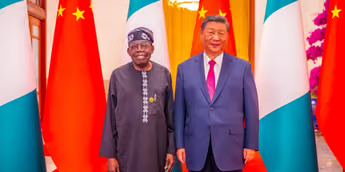
President of Nigeria is Bola Ahmed Tinubu and president of China is Xi Jinping
The growth came as total trade between both countries expanded by 35 per cent to $17.4 billion between January and June, reflecting stronger commercial activity between Africa’s most populous country and the world’s second-largest economy.
The figures were disclosed by Yang Jiaxing, Cultural Counsellor of the Chinese Embassy in Nigeria and Director of the China Cultural Centre, during an event in Abuja on Thursday, November 12.
Yang attributed the growth to expanding economic cooperation and improved access to the Chinese market, particularly following Beijing’s decision to introduce zero-tariff treatment for products from 53 African countries, including Nigeria.
The policy took effect on May 1, 2026, removing import duties on qualifying goods from eligible African countries. It is intended to encourage African producers to increase exports to China and strengthen commercial relations between the two regions.
CHINA'S IMPORTS FROM NIGERIA GAIN MOMENTUM
Nigeria's export performance was particularly notable in May and June, when the value of goods imported from the country recorded year-on-year growth of more than 40 per cent in each month.
The increase contributed to the overall 81 per cent expansion recorded during the six-month period.
The figures indicate that Nigerian businesses are gaining greater access to one of the world's largest consumer and industrial markets. Products eligible for the new tariff arrangement can enter China without the import duties previously charged, potentially reducing costs for exporters.
Among the Nigerian products identified as benefiting from improved market access are sesame, cattle-bone granules and liquefied propane.
The stronger export figures also come amid efforts by both governments to expand trade beyond conventional commodity exchanges and encourage greater cooperation in agriculture, manufacturing, investment and industrial development.
The increase represents progress for Nigerian exporters, the available figures do not provide a detailed breakdown showing how much each product contributed to the growth.
CHINA-AFRICA TRADE RECORDS STRONG GROWTH
Nigeria's performance forms part of a wider expansion in commercial relations between China and African countries.
Yang disclosed that China-Africa trade exceeded $207.4 billion in the first half of 2026, setting a record for the corresponding period.
He also reported that China's imports from Africa reached $28.5 billion between May and June, representing a 23.5 per cent increase compared with the same period a year earlier.
African aquatic products, textile raw materials and specialty fruits were among the categories recording double-digit growth in the Chinese market.
The zero-tariff arrangement is expected to create additional opportunities for African producers by lowering the cost of accessing Chinese consumers and businesses.
China has presented the policy as part of its broader economic engagement with African countries, with the objective of expanding trade and strengthening cooperation across different sectors.
TRADE GROWTH DOES NOT YET MEAN A BALANCED RELATIONSHIP
Despite the sharp increase in Nigerian exports, the overall trade relationship remains heavily weighted towards goods supplied by China.
The $17.4 billion bilateral trade figure includes both Nigerian exports to China and Chinese exports to Nigeria. China's imports from Nigeria accounted for $2.25 billion of that total, meaning the bulk of the reported trade value came from goods moving in the opposite direction.
This highlights the scale of the challenge facing Nigeria as it seeks to improve its position in international trade.
Nigeria imports substantial quantities of manufactured and industrial products from China, while its exports to the Asian country remain concentrated in commodities and raw materials.
Expanding the range of Nigerian products sold in China, improving local processing capacity and supporting businesses to meet international quality requirements will be important to achieving a more diversified export base.
The increase in export earnings is therefore an encouraging development, but sustained growth will depend on Nigeria's ability to increase production and supply more competitive goods to the Chinese market.
MANDARIN SERVICE LAUNCHED BY VOICE OF NIGERIA
The trade figures were announced during the launch of the Mandarin-language service of Voice of Nigeria (VON) and the celebration of the China-Nigeria Bridge Programme in Abuja.
The introduction of Mandarin makes it the broadcaster's ninth language, joining English, French, Arabic, Hausa, Igbo, Yoruba, Fulfulde and Swahili.
VON Director-General Jibrin Baba Ndace said the new service would help Nigeria communicate its stories, culture, tourism opportunities and business potential to Chinese-speaking audiences.
He was represented at the event by the Director of General Services, Danladi Abubakar.
The China-Nigeria Bridge Programme was jointly initiated by the Chinese Embassy, the Africa Regional Bureau of Xinhua News Agency and Voice of Nigeria, with the China Cultural Centre serving as a supporting partner.
The initiative combines Mandarin lessons with reports on China-Africa relations and is designed to strengthen cultural understanding, media cooperation and communication between people in both countries.
Ndace also recalled agreements and cooperation initiatives involving Nigerian and Chinese media institutions, including content sharing, staff training and broadcasting development.
Nigeria Press Council Executive Secretary Dili Ezughah also welcomed the initiative, describing stronger media collaboration as an important part of building lasting relations between the two countries.
The programme reflects a broader effort to deepen relations beyond trade and government engagements by improving communication and cultural exchange.
ZERO-TARIFF POLICY PRESENTS OPPORTUNITY FOR NIGERIAN EXPORTERS
China's decision to extend zero-tariff treatment to 53 African countries has created a new opening for businesses seeking to sell products in the Asian market.
The policy could help Nigerian exporters reduce the cost of entering China, but access to the market will also depend on production capacity, product quality, regulatory compliance and the ability to maintain consistent supplies.
For Nigeria, the next challenge is turning improved access into sustained export growth, particularly through agricultural processing, manufacturing and products with greater local value addition.
The latest figures show that Nigerian exports to China are growing much faster than the overall bilateral trade relationship. Whether that momentum can be maintained will depend on how effectively businesses and policymakers take advantage of the expanded market access.