United States
Mamdani Moves to Disband NYPD’s Controversial Strategic Response Group, Announces New Protest Policing System
New York City Mayor Zohran Mamdani has announced plans to disband the New York Police Department’s Strategic Response Group (SRG), a specialised unit ...
By Wavers News
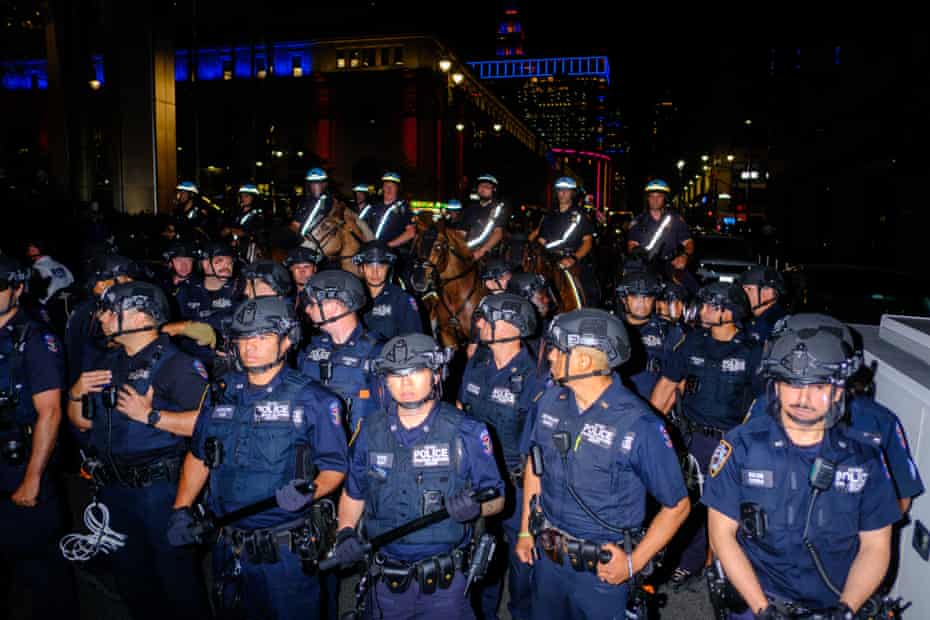
Riot police stand guard during Game 5 of the NBA Finals between the Knicks and the San Antonio Spurs in New York on 13 June 2026. Photograph: Julius Constantine Motal/The Guardian
The announcement, made on Monday, November 16, 2026, fulfils a commitment Mamdani made during his mayoral campaign. The mayor said the city would adopt a different approach to managing protests, with greater emphasis on communication, de-escalation and civilian coordination.
The SRG was established in 2015 with responsibilities that included counterterrorism operations and responding to major demonstrations. Civil rights organisations have repeatedly challenged its protest policing methods, accusing officers of using unnecessarily aggressive tactics against demonstrators.
In a video released on Monday, Mamdani confirmed that his administration was carrying out the campaign promise, saying the changes were intended to separate the way police handle terrorism threats from their response to people exercising their constitutional right to protest.
The restructuring was announced jointly with Police Commissioner Jessica Tisch, who backed the changes and said the new arrangement would maintain the department's ability to protect residents while improving its operational structure.
NEW CIVILIAN-LED DIVISION TO HANDLE PROTEST ENGAGEMENT
A central part of the new arrangement is the creation of a Community Dialogue and De-escalation Division (CDDD) within the mayor's Office of Community Safety.
The division will take a civilian-led approach to preparing for and responding to public demonstrations. Its responsibilities will include engaging with communities and protest organisers, encouraging communication and helping to reduce tensions before and during demonstrations.
Unlike the disbanded SRG, the new civilian division will not carry weapons or possess arrest powers.
The administration says the arrangement is intended to make dialogue and peaceful engagement central to the city's protest response, rather than relying primarily on the deployment of heavily equipped police officers.
The civilian division will work alongside a specialised team within the NYPD known as the First Amendment Support Team (FAST).
NYPD TO CREATE 30-OFFICER FIRST AMENDMENT SUPPORT TEAM
The First Amendment Support Team will operate within the NYPD's Community Affairs Bureau and consist of 30 uniformed officers trained in communication and de-escalation.
The team will work with the civilian division to improve how the police department prepares for demonstrations and interacts with people taking part in them.
The new structure is designed to give protest response a dedicated approach that recognises the constitutional protections surrounding freedom of speech and peaceful assembly.
The administration has also announced the establishment of a Patrol Support Division within the NYPD's Patrol Services Bureau.
The division will be staffed by vetted officers who will primarily carry out patrol-related responsibilities while receiving specialised training in crowd management. They will provide support during demonstrations when additional police assistance is required.
The changes will redistribute responsibilities previously handled by the Strategic Response Group rather than remove the NYPD's ability to respond to public safety incidents.
COUNTERTERRORISM DUTIES TO MOVE TO INTELLIGENCE BUREAU
Under the new arrangement, the SRG's counterterrorism responsibilities will be transferred to the NYPD's Intelligence and Counterterrorism Bureau.
These responsibilities include the deployment of heavy weapons at critical infrastructure and other counterterrorism-related operations.
The transfer is intended to establish a clearer separation between counterterrorism activities and the policing of demonstrations.
Mamdani and Tisch said the restructuring would allow the department to organise its specialised security functions while developing a different system for handling protests.
Tisch maintained that the changes would not weaken the NYPD's capacity to respond to serious threats. She said the department must remain prepared to protect New Yorkers and ensure officers have the resources needed to carry out their duties.
NEW RESTRICTIONS ON POLICE TACTICS DURING PROTESTS
The reforms also introduce restrictions on the methods and equipment police officers can use when responding to demonstrations.
Under the announced rules, officers will be prohibited from using irritant gas, including tear gas, and long guns during protest activities protected by the First Amendment.
The practice known as kettling, in which police surround and contain demonstrators within a restricted area, will also be banned.
Pepper spray will no longer be permitted as a general crowd-management tool during demonstrations. Long-range acoustic devices, which can produce loud sounds to affect crowds, will be restricted to a maximum level of 90 decibels.
The restrictions are intended to reduce the use of tactics that have attracted criticism from protesters and civil liberties advocates.
The changes also address concerns about the deployment of heavily armed officers and specialised equipment at demonstrations that do not present the same level of threat as counterterrorism operations.
CONTROVERSY OVER SRG DATES BACK TO 2020 PROTESTS
The Strategic Response Group has been at the centre of disputes over police conduct for several years, particularly following widespread demonstrations in New York in 2020 after the killing of George Floyd by a Minneapolis police officer.
During those protests, SRG officers faced criticism over the use of kettling, pepper spray, batons and other forceful crowd-control methods.
The police response generated multiple lawsuits and financial settlements involving the city.
Following the protests, New York City's Department of Investigation recommended that the NYPD reassess the SRG's central role in responding to large demonstrations. The recommendation questioned whether a unit established to handle counterterrorism, riots and other serious threats was appropriate for routine protest policing.
Mamdani also renewed his commitment to disband the unit in January after SRG officers arrested demonstrators occupying a hotel lobby during protests against Immigration and Customs Enforcement (ICE).
The decision to dismantle the group therefore follows years of public criticism and demands from civil rights advocates for changes to the department's protest response procedures.
POLICE UNION OPPOSES THE DECISION
The announcement has received support from civil rights groups, but the police union has strongly criticised the restructuring.
Patrick Hendry, president of the New York Police Benevolent Association, argued that eliminating the specialised unit could undermine public safety and place police officers at greater risk.
He accused Mamdani of prioritising political supporters over the safety of residents and officers, warning that the city could face difficulties when demonstrations involve blocked roads, bridges or serious public disorder.
The disagreement highlights the different positions surrounding the future of protest policing in New York, with civil liberties advocates seeking stronger restrictions on police tactics and the union arguing that specialised capabilities remain necessary to maintain public order.
REFORMS TO BE IMPLEMENTED WITHOUT ADDITIONAL COST
The Mamdani administration said the restructuring would be carried out without additional expenditure or changes to the NYPD's overall workforce.
The department will not increase or reduce its existing headcount as part of the changes. Officers currently assigned to the SRG will be reassigned to other responsibilities under the new structure.
The administration maintains that separating counterterrorism operations from protest response, while introducing dedicated teams for communication and crowd management, will improve the department's ability to address different public safety situations.
The move marks a significant change in how New York City intends to manage demonstrations and deploy specialised police resources, while placing greater emphasis on protecting the right to peaceful assembly.