International
France Faces Risk of Losing DR Congo as Francophonie Leadership Dispute Deepens
France is facing another diplomatic challenge in Africa as tensions between Rwanda and the Democratic Republic of Congo (DR Congo) over the leadership...
By Wavers News
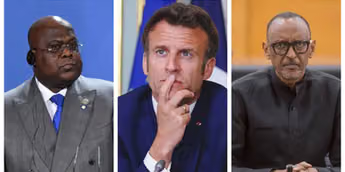
DR Congo President Félix Tshisekedi, French President Emmanuel Macron and Rwandan President Paul Kagame amid a dispute over the leadership of the Francophonie
The dispute has placed French President Emmanuel Macron in a difficult diplomatic position as he seeks to prevent a leadership contest from escalating into a wider disagreement among member states.
At the centre of the controversy is the re-election bid of Rwanda's Louise Mushikiwabo, the organisation's current secretary-general, who is seeking a third four-year term. Her candidacy has faced opposition from DR Congo, which initially nominated former culture minister Juliana Amato Lumumba.
Macron has reportedly encouraged Rwanda to withdraw Mushikiwabo's nomination in favour of former Romanian Prime Minister Dacian Cioloș, who has emerged as a possible compromise candidate.
Rwanda has rejected the proposal and maintained its support for Mushikiwabo, while DR Congo has now withdrawn its candidate and announced support for Cioloș.
The leadership election is scheduled for November 16 during the 20th Francophonie Summit in Phnom Penh, Cambodia.
DR CONGO WITHDRAWS ITS CANDIDATE
DR Congo's decision to withdraw Lumumba's candidacy represents a significant change in the contest, particularly after months of diplomatic tension between Kinshasa and Kigali.
On November 14, Congolese Foreign Affairs Minister Thérèse Kayikwamba Wagner announced that her government was prepared to withdraw its nominee to help establish a consensus around a candidate capable of uniting member states.
Following consultations with Romania, Kinshasa moved to support Cioloș, the country's former prime minister and a former European Commissioner for Agriculture.
Cioloș welcomed the support, thanking DR Congo for its confidence in his vision and commitment to consensus within the organisation.
The decision has changed the direction of the leadership contest, shifting DR Congo's position from directly challenging Rwanda's candidate to backing an alternative European nominee.
The development also introduces a new dimension to the disagreement, as Rwanda has questioned the decision to support a candidate from outside Africa despite the presence of African nominees in the race.
RWANDA REJECTS PRESSURE TO WITHDRAW
Rwanda has maintained that Mushikiwabo should remain in the contest despite diplomatic efforts to produce a compromise.
Foreign Affairs Minister Olivier Nduhungirehe rejected the reported request from Macron, insisting that his country's candidate would not withdraw.
Kigali's position reflects its determination to defend Mushikiwabo's record and seek another term at the head of the organisation.
The Rwandan government has also questioned DR Congo's decision to support Cioloș, arguing that the move conflicts with an African Union position encouraging support for African candidates seeking leadership positions in international institutions.
The African Union's position has added another political dimension to the contest, as African governments consider whether regional representation should influence their choices.
Mauritania's Coumba Bâ is also among the candidates seeking the position, meaning the contest involves nominees from Rwanda, Mauritania and Romania following DR Congo's withdrawal.
A LEADERSHIP DISPUTE ROOTED IN REGIONAL TENSIONS
The disagreement over the OIF leadership comes against the background of deteriorating relations between Rwanda and DR Congo over the security situation in eastern Congo.
Kinshasa has repeatedly accused Kigali of supporting the M23 armed group, which has been involved in fighting against Congolese forces and has seized territory in the country's eastern provinces.
Rwanda has consistently denied supporting armed groups operating in DR Congo.
The conflict has contributed to diplomatic confrontations between the two governments, with disagreements extending into regional security discussions and international diplomatic engagements.
The Francophonie leadership contest has consequently become another platform where the strained relationship between the neighbouring countries is visible.
DR Congo has also reportedly threatened to reconsider its membership of the organisation if Mushikiwabo secures another term. Such a departure would represent a major setback for the OIF because of the country's population and its importance within the French-speaking world.
With more than 110 million people, DR Congo is the most populous country where French is an official language. Its departure would therefore have significant implications for the organisation's reach and representation.
FRANCE'S INFLUENCE WITHIN THE FRANCOPHONIE
The International Organisation of La Francophonie brings together 90 states and governments, including 53 full members with voting rights. Its activities extend beyond promoting the French language to include education, cultural exchange, economic cooperation, diplomacy and democratic development.
France remains one of its most influential members and the largest financial contributor to the organisation.
Its position gives Paris considerable diplomatic weight, although financial contributions do not determine voting rights in the selection of the secretary-general.
The current disagreement highlights the difficulty France faces in maintaining influence within a group whose membership includes countries with increasingly diverse political and economic priorities.
Macron's reported support for Cioloș reflects an effort to avoid a direct confrontation between Rwanda and DR Congo while preserving unity within the organisation.
The situation also demonstrates that France cannot automatically secure agreement among African members, particularly when their national interests and regional political relationships are involved.
AFRICA'S CHANGING RELATIONSHIP WITH FRANCE
The leadership dispute comes as France continues to face difficulties maintaining its traditional political, military and diplomatic relationships across parts of Africa.
Mali, Burkina Faso and Niger announced their withdrawal from the Francophonie in March 2025 after their memberships had been suspended following military coups.
Their departures came amid wider disagreements with France over military cooperation, political influence and sovereignty.
The three countries had already taken steps to reduce their security and diplomatic dependence on Paris, reflecting a broader shift in their foreign policy relationships.
At the same time, other international powers, including China, Russia, Turkey and Gulf countries, have expanded their engagement across Africa through trade, infrastructure investment, security cooperation and diplomatic partnerships.
These developments have created a more competitive international environment in which African governments increasingly seek to diversify their external relationships.
DR Congo's possible departure from the Francophonie would add another challenge to France's efforts to maintain its influence within the French-speaking world.
THE DECISION AHEAD
The 20th Francophonie Summit in Phnom Penh is expected to bring together leaders and representatives from the organisation's 90 member states and governments to discuss cooperation, peace, economic development and the future direction of the institution.
The selection of the next secretary-general is one of the most important decisions scheduled for the gathering.
Under the organisation's election rules, consensus is the preferred approach. If member states fail to reach an agreement, the leaders of the 53 full members can proceed to a secret ballot, with the candidate receiving the highest number of votes winning the position.
The next secretary-general will serve a four-year term covering 2027 to 2030.
The outcome will determine whether Mushikiwabo secures another term, whether Cioloș gains sufficient support as a compromise candidate or whether Mauritania's Coumba Bâ emerges as an alternative.
Beyond the leadership selection, the dispute has exposed growing disagreements over representation, regional solidarity and the influence of major financial contributors within the organisation.
For France, the challenge is not limited to securing a preferred candidate. It also involves preventing further divisions within a diplomatic institution that remains central to its relationships with French-speaking countries across Africa and other regions.