News
Türkiye Plans Local Defence Production Facilities in Nigeria, Targets $5bn Trade Partnership
Türkiye is planning to establish local defence production facilities and a military training centre in Nigeria as both countries move to expand their ...
By Wavers News
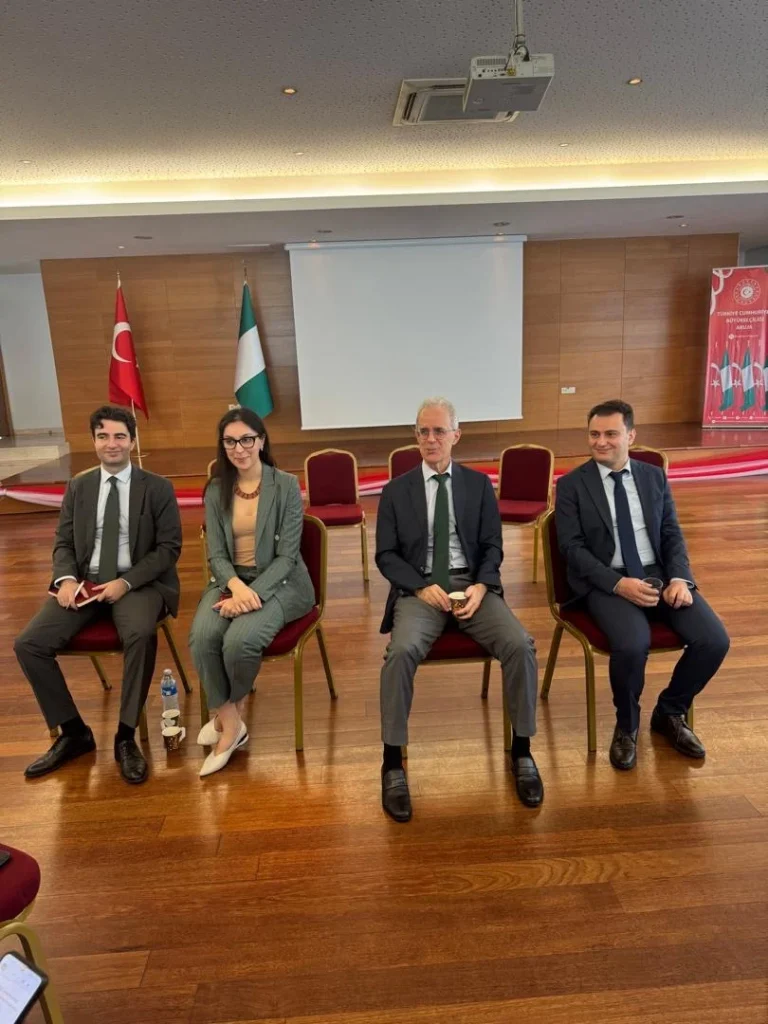
Ambassador of the Republic of Türkiye to Nigeria Mehmet Poroy, (second on the right), with other officials of Embassy on Monday in Abuja Photo Credit: Deborah Musa
Turkish Ambassador to Nigeria, Mehmet Poroy, disclosed the plans on Monday, November 9, 2026, during a press briefing in Abuja marking 66 years of diplomatic relations between the two countries.
The proposed facilities would represent a shift in the countries' defence relationship, which has largely involved Nigeria purchasing military equipment from Turkish manufacturers. The new arrangement is expected to create opportunities for some defence equipment to be produced locally, although the ambassador did not disclose the proposed locations, investment amounts, construction timeline or specific products to be manufactured.
Poroy explained that Türkiye wanted its cooperation with Nigeria to extend beyond supplying weapons and military equipment to supporting local production and strengthening the country's defence manufacturing capacity.
The initiative forms part of wider efforts to implement agreements reached during President Bola Tinubu's state visit to Türkiye earlier in 2026. The visit involved nine Nigerian ministers and resulted in the signing of nine bilateral agreements and memoranda of understanding.
200 NIGERIAN SPECIAL FORCES PERSONNEL UNDERGOING TRAINING IN TÜRKİYE
Alongside the proposed production facilities, both countries are working towards establishing a military training centre in Nigeria to improve the capacity of the Nigerian Armed Forces.
Poroy disclosed that 200 Nigerian special forces personnel were undergoing a two-month training programme in Türkiye, with the participants expected to complete the exercise after their period of instruction.
The planned Nigerian training facility would allow military personnel to receive continuous training within the country, supported by Turkish military officers. This would reduce the need to send personnel abroad for every specialised training programme.
The ambassador said the arrangement would provide a more sustainable system for developing military skills and strengthening cooperation between the armed forces of both countries.
He also offered to share Türkiye's experience in combating terrorism, drawing on its decades-long struggle against terrorist organisations.
Poroy said his country had lost more than 40,000 people during approximately 40 years of confronting terrorism and had spent billions of dollars addressing the threat.
He stressed that tackling insecurity required more than military operations, pointing to economic, religious and other factors that could contribute to terrorism.
The Nigerian military already operates Turkish-made attack helicopters and drones, which are being used in security operations, particularly in the northern part of the country.
BOTH COUNTRIES TARGET $5BN IN BILATERAL TRADE
Beyond defence cooperation, Türkiye and Nigeria are seeking to increase their annual trade volume from approximately $2 billion to $5 billion.
Poroy said the target followed instructions from President Tinubu and Turkish President Recep Tayyip Erdoğan during their discussions earlier in the year.
The ambassador described the existing trade relationship as below its potential, considering the size of the Nigerian economy and opportunities available to businesses in both countries.
He disclosed that Türkiye's total trade with African countries stood at approximately $37 billion, while its trade with Nigeria was about $2 billion, including oil and gas.
To strengthen commercial relations, the Turkish embassy has been engaging business organisations and chambers of commerce in Abuja, Kano, Kaduna and Lagos to identify investment opportunities and encourage partnerships between companies.
The embassy is also facilitating visa procedures for Nigerian businesspeople to make it easier for them to travel to Türkiye and establish direct business relationships with Turkish companies.
Poroy said stronger private-sector connections would be important to achieving the proposed trade target.
TURKISH INVESTMENT AND HUMANITARIAN SUPPORT IN NIGERIA
The ambassador also highlighted the need to attract more Turkish investment into Nigeria, noting that Turkish investments across Africa exceeded $10 billion, while the amount invested in Nigeria remained below $1 billion.
He said expanding investment opportunities would be important to strengthening economic cooperation and encouraging more Turkish companies to establish operations in the country.
On humanitarian assistance, Poroy disclosed that the Turkish government had provided food support to 3,000 internally displaced families in Adamawa State.
He added that Turkish non-governmental organisations, including the Turkish Religious Affairs Foundation, spent approximately $5 million on humanitarian activities in Nigeria during the previous year.
The interventions included food donations and meat distribution to vulnerable people during Ramadan and Eid al-Adha.
The ambassador said Türkiye intended to continue supporting communities affected by displacement and hardship, while exploring ways to coordinate humanitarian activities more closely with Nigerian authorities.
66 YEARS OF DIPLOMATIC RELATIONS
Poroy used the anniversary briefing to highlight the historical relationship between Nigeria and Türkiye, explaining that diplomatic relations between the two countries were elevated to ambassadorial level on November 9, 1960, shortly after Nigeria gained independence.
He clarified that Türkiye had established a Consulate-General in Lagos on April 19, 1959, while Nigeria was still under British colonial administration. The first Turkish ambassador arrived in Nigeria in 1962.
He also recalled historical connections between the Ottoman Empire and the Kanem-Borno Sultanate, dating back to the 16th century, including diplomatic correspondence between their rulers.
The ambassador further highlighted the historical association with Lagos through the Shitta Bey Mosque, whose founder received the title of Bey from the Ottoman Sultan.
As part of efforts to strengthen cultural relations, Poroy announced that an art exhibition titled In Nature, featuring works by his wife, would open at the Ministry of Foreign Affairs Art Gallery in Abuja on November 20.
He described Nigeria as an important strategic partner for Türkiye, particularly because of its influence on security, economic development and stability in West Africa.