International
Trump Says He Would Welcome a United Ireland During Dublin Visit
U.S. President Donald Trump has said he would like to see Ireland and Northern Ireland become united, arguing that Irish unity will eventually happen....
By Wavers Multimedia
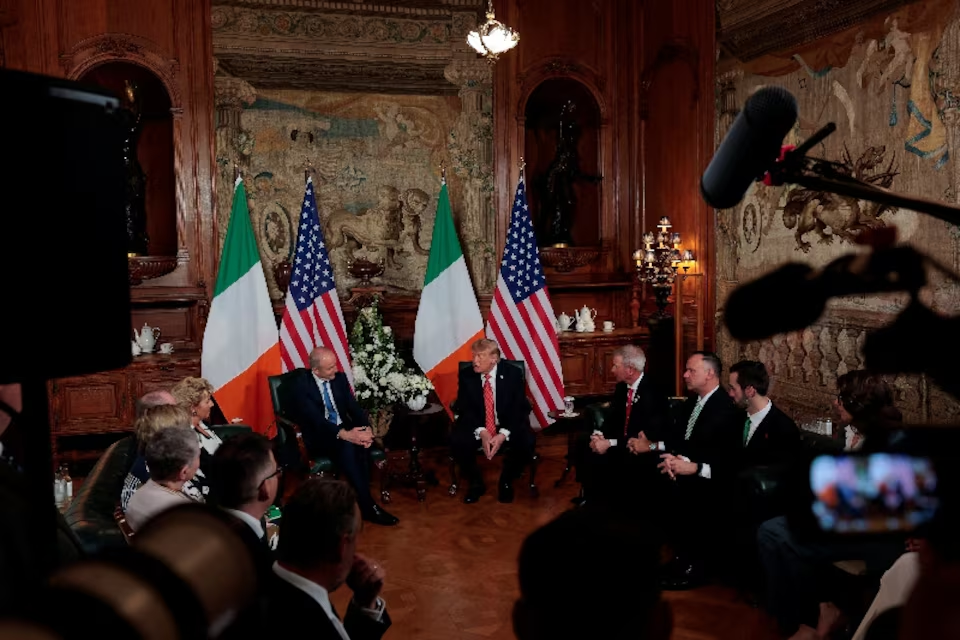
Trump made the comments on Saturday during his visit to Dublin, where he met Irish Prime Minister Micheál Martin.
Asked about the possibility of Ireland and British-run Northern Ireland becoming one country, Trump said he would “love” to see it happen and described a united Ireland as something he believed would eventually become reality.
He also acknowledged that the United Kingdom would have a role in any decision concerning Northern Ireland.
Comments challenge traditional US neutrality
Trump’s position represents a departure from the approach taken by previous U.S. presidents, who have generally avoided taking sides on the question of Irish unification.
The issue remains politically sensitive because Northern Ireland is part of the United Kingdom, while Irish nationalists have long supported the creation of a united Ireland.
Under the 1998 Good Friday Agreement, a referendum on Northern Ireland’s constitutional status can be called at the discretion of the British government. The agreement brought an end to three decades of violence between nationalists seeking a united Ireland and unionists who wanted Northern Ireland to remain within the UK.
Trump later acknowledged that there was no simple answer to the question of Irish unity but maintained that he viewed unification as a positive development.
Unionists reject Trump’s prediction
Trump’s remarks were quickly rejected by pro-British unionists in Northern Ireland.
Gavin Robinson, leader of the Democratic Unionist Party, said Northern Ireland’s constitutional future should be determined by the people of Northern Ireland rather than by political figures in London, Dublin or Washington.
Robinson, who has previously supported Trump, also rejected the U.S. president’s prediction that Irish unification would eventually happen.
Opinion polls continue to show a comfortable majority in Northern Ireland favouring remaining part of the United Kingdom, although the gap has narrowed somewhat since Britain’s departure from the European Union pushed the question of Irish unity higher on the political agenda.
Supporters of Irish unity in Belfast also reacted cautiously. Eamon Hanna, a supporter of the nationalist SDLP party, questioned whether Trump genuinely cared about the issue and suggested his comments were primarily aimed at attracting headlines.
UK government position remains unchanged
Trump’s comments came only weeks after British Prime Minister Andy Burnham said a referendum on Northern Ireland leaving the United Kingdom was currently “off the table.”
Downing Street said on Saturday that the British government’s position had not changed following Trump’s remarks.
The issue therefore remains a matter for the people of Northern Ireland and the constitutional process established under the Good Friday Agreement.
Trump meets Irish president
During his visit, Trump also met Irish President Catherine Connolly.
Connolly said she conveyed to Trump the Irish people’s strong opposition to what she described as the normalisation of war and genocide.
Her statement did not identify a specific conflict, although she has previously criticised the U.S. war with Iran and Israel’s military campaign in Gaza. Ireland has described the situation in Gaza as genocide, a characterization rejected by Israel.
Trump’s visit also prompted a large anti-war demonstration in Dublin. Thousands of protesters marched through the city after Trump left to attend a golf tournament at one of his resorts in western Ireland.
Some protesters carried signs accusing Trump of being a warmonger and chanted in support of Palestine. The demonstration was described as one of Ireland’s largest anti-war protests in recent years.
Trump highlights US-Ireland economic ties
Despite the political tensions surrounding his visit, economic relations between the United States and Ireland were also a major focus.
U.S.-owned companies, particularly in the technology and pharmaceutical industries, employ about 10% of Ireland’s workforce. Successive Irish governments have spent decades encouraging American companies to establish operations in the country, bringing jobs and tax revenues.
Trump joked about the large presence of American medical companies in Ireland, saying the United States should get some of them back.
He nevertheless described the relationship between the two countries as excellent and said there was room for both sides to benefit.
Trump’s visit comes as his comments on Irish unity add a new dimension to the long-running debate over Northern Ireland’s constitutional future, while also highlighting the close political, economic and historical ties between the United States and Ireland.