International
Spain Train Collision Kills at Least 30 as Two High-Speed Trains Crash in Toledo
At least 30 people have been killed after two high-speed passenger trains collided in central Spain, triggering a major emergency response and forcing...
By Wavers News
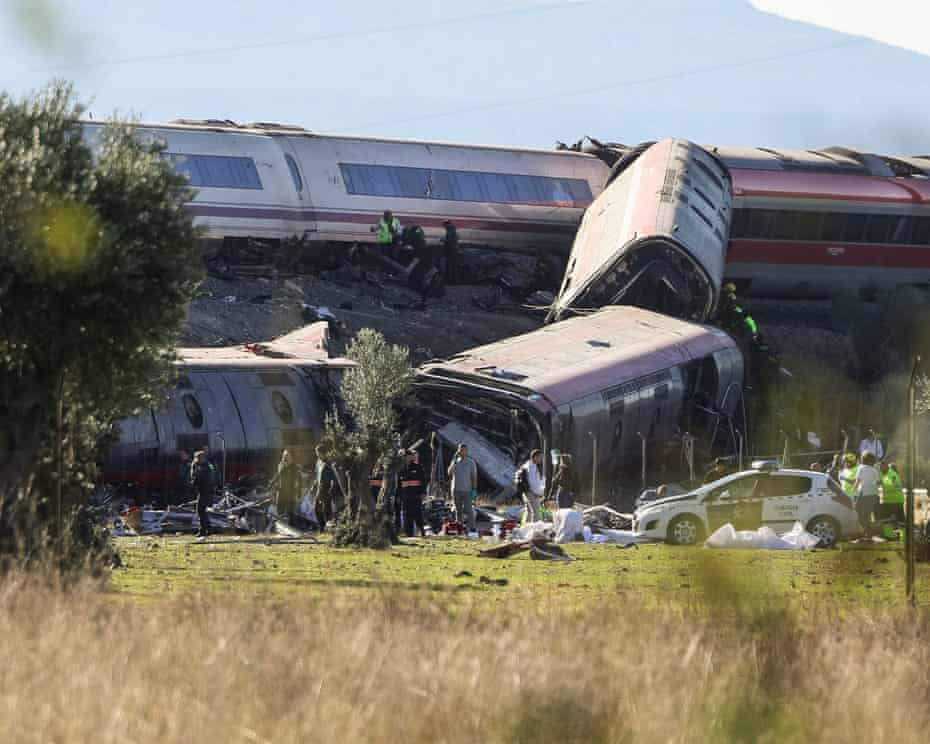
The crash occurred on Wednesday morning in Toledo province, on the railway line linking Madrid and Seville. The collision involved a train operated by Spain's state-owned rail company Renfe and another run by private operator Iryo.
Regional authorities said the death toll had risen from an initial estimate of 10 as emergency workers continued responding to the disaster. Hundreds of passengers were travelling on the two trains, and officials warned earlier that the number of casualties could increase further.
Initial reports indicated that one train struck the rear of another that had stopped on the tracks. The impact derailed two carriages, leaving wreckage scattered across an embankment beside the railway.
The cause of the collision had not been established as of Wednesday, and investigators were still working to determine the sequence of events that led to the crash.
The disaster has shocked Spain, which suffered another major railway tragedy in January when a collision near Adamuz in Córdoba province killed 46 people.
COLLISION INVOLVED TWO PASSENGER TRAINS
The accident occurred near the towns of Urda and Los Yébenes in Toledo province, approximately 100 kilometres south of Madrid.
The trains were travelling along the route connecting the Spanish capital with Seville, a major city in the country's southern region of Andalusia.
Information released by regional authorities indicated that both trains were travelling in the same direction when the collision happened.
One of the trains had stopped on the tracks before the other struck its rear. The force of the impact sent two carriages off the railway line, creating a difficult situation for passengers and emergency responders.
The two services were operated by different companies. Renfe is Spain's state-owned railway operator, while Iryo is a private high-speed rail company.
Authorities had not provided a complete explanation of why the train ahead stopped or why the following service failed to avoid the collision.
Those questions are expected to form part of the investigation into the accident.
WRECKAGE SCATTERED ACROSS EMBANKMENT
Images broadcast by regional television showed severely damaged railway carriages at the scene, with twisted metal, broken panels and other debris scattered across the ground beneath the tracks.
At least one derailed carriage remained on an elevated section of railway infrastructure, while other wreckage lay along the embankment.
The damage complicated the immediate rescue operation as emergency personnel worked to reach affected passengers and assess the condition of the carriages.
A passenger identified only as Miguel, who was travelling in the rear carriage of one of the trains with several colleagues, described hearing a powerful impact.
He said the noise lasted several seconds and initially gave the impression that the train itself was about to derail.
Looking through a window, he saw a damaged train nearby, which he believed was the other service involved in the collision.
His account offered a passenger's perspective on the force of the impact, although the precise sequence of the collision remained under investigation.
The condition of the damaged carriages and the possibility of further casualties made the work of emergency crews particularly urgent.
DEATH TOLL RISES AS AUTHORITIES ASSESS CASUALTIES
The regional government of Castilla-La Mancha confirmed that the number of deaths had increased to at least 30 by Wednesday.
Earlier information had placed the death toll at 10, but officials subsequently reported a substantial increase as the scale of the disaster became clearer.
Esther Padilla, a spokesperson for the regional government, said the collision involved two high-speed trains carrying hundreds of passengers.
Authorities had warned that the number of people killed or injured could rise as rescue workers continued examining the scene and assisting those affected.
The full number of injured passengers had not been conclusively established in the available updates at the time of publication.
The mayor of Urda, Manuel Galán, said emergency services had asked the municipality to prepare a sports hall to accommodate injured passengers and assist with the emergency response.
The request reflected the scale of the incident and the need for additional space to support those affected outside the immediate crash site.
Authorities were continuing to coordinate emergency assistance while seeking to establish the full human cost of the collision.
RAIL SERVICES BETWEEN MADRID AND ANDALUSIA SUSPENDED
Spain's railway infrastructure authority, Adif, suspended high-speed services on the Madrid-Andalusia line following the collision.
The disruption affected an important transport connection used by passengers travelling between Madrid and cities in southern Spain, including Seville.
Rail services between Madrid, Ciudad Real and Andalusia were also affected as the authorities responded to the accident.
The suspension was necessary while emergency crews worked at the scene and railway officials assessed the condition of the tracks and infrastructure.
Renfe announced that affected passengers could request changes to their bookings or cancellations without paying the usual fees.
The disruption created uncertainty for travellers who had planned to use the route on Wednesday, with the authorities yet to establish a confirmed timetable for the full resumption of services.
The accident also placed pressure on transport officials to provide information about alternative arrangements and the likely duration of the disruption.
The route is an important part of Spain's high-speed rail network, which connects major cities and carries large numbers of passengers each year.
CAUSE OF COLLISION REMAINS UNKNOWN
Investigators had not established the cause of Wednesday's crash at the time of publication.
Regional officials said one train had stopped before being struck from behind, but they had not confirmed why it stopped or what prevented the second train from avoiding the collision.
Railway authorities were expected to examine the circumstances surrounding the movement of both trains, along with relevant operational and technical information.
The investigation will need to establish whether the collision resulted from a technical failure, an operational error or another factor.
No definitive finding had been announced, and it would be premature to attribute responsibility to a train driver, railway controller or infrastructure fault without evidence from the investigation.
The crash has renewed scrutiny of railway safety in Spain, particularly because the country experienced another fatal high-speed rail disaster earlier in the year.
The findings of the investigation will be important in determining what happened and whether any safety measures need to be reviewed.
SPANISH PRIME MINISTER EXPRESSES SHOCK
Prime Minister Pedro Sánchez said he was shocked by the collision and was maintaining contact with Transport Minister Óscar Puente and the president of Castilla-La Mancha, Emiliano García-Page.
Sánchez said emergency services were working at the scene to assist affected passengers and protect their safety.
He also expressed solidarity with the victims and their families.
The government's immediate priority was to support rescue operations and ensure that injured passengers received assistance, while authorities worked to establish the circumstances of the crash.
Opposition leader Alberto Núñez Feijóo also expressed concern, saying the priority was to care for the victims and support their families.
He praised the emergency teams working at the scene.
Spain's main political parties suspended their planned activities for Wednesday following news of the disaster. The parties had been preparing for the country's general election scheduled for next month.
The decision reflected the seriousness of the incident and the national attention focused on the rescue effort.
SPAIN RECALLS DEADLY JANUARY RAIL DISASTER
The Toledo collision has brought renewed attention to the railway disaster near Adamuz in Córdoba province in January 2026.
That accident killed 46 people and injured more than 150 after two high-speed trains collided.
The incident became one of the country's deadliest railway disasters in recent decades and prompted questions about the safety and operation of the rail network.
Spain also experienced a major train derailment near Santiago de Compostela in 2013, when 80 people died.
Wednesday's collision is a separate incident, and investigators have not established a connection between the latest crash and the earlier disasters.
The repeated occurrence of major railway accidents has nevertheless increased public concern about passenger safety and the need for thorough investigations whenever a serious incident occurs.
Spain operates one of the world's largest high-speed railway networks, connecting major urban centres and providing an important alternative to road and air travel.
The network's size and popularity make the safety of its infrastructure, trains and operating procedures a significant national concern.
RESCUE AND INVESTIGATION EFFORTS CONTINUE
Emergency services remained focused on assisting passengers, assessing casualties and responding to the damage caused by the collision.
Officials were also working to establish the complete sequence of events and determine the factors that led to one train striking another.
The death toll stood at at least 30 in the latest update available for this report, but authorities had warned earlier that the number could rise. The final number of casualties and the full extent of the injuries had not yet been established.
The suspension of high-speed services between Madrid and Andalusia was another immediate consequence, affecting passengers and transport operations across the region.
For the victims and their families, attention remained on identifying those killed, providing medical care to the injured and obtaining reliable information about what happened.
The investigation will determine how the collision occurred and whether failures in train operations, infrastructure or other systems contributed to the disaster.
Until those findings are released, the precise cause of the crash remains unknown.