News
South Korea Weighs Possible Strait of Hormuz Mission With US, UK and France
South Korea is considering whether to take part in international efforts to protect freedom of navigation through the strategically important Strait o...
By Wavers Multimedia
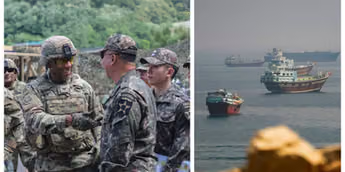
The South Korean government is reviewing both military and non-military options, although officials have stressed that no final decision has been made on deploying military assets. The discussions include possible coordination with the United States, the United Kingdom and France.
Several options are reportedly being examined, including the deployment of a maritime patrol aircraft, a logistics support vessel or a unit capable of detecting and clearing naval mines.
A South Korean presidential official said the government has been discussing practical ways to contribute to international efforts to keep the waterway open. However, the official rejected reports suggesting that Seoul had already decided to send forces to the region.
Any overseas military deployment would also have to go through South Korea's domestic legal procedures, including approval from the National Assembly. The government must additionally consider the country's military readiness on the Korean Peninsula before making a decision.
The Strait of Hormuz has become a major security concern amid the continuing conflict involving the United States and Iran. Commercial shipping through the waterway has fallen sharply, with only four commodity vessels recorded crossing on Thursday, compared with a 10-day average of 15, according to Kpler data cited by Reuters.
The situation is particularly important to South Korea because of its heavy reliance on energy shipments passing through the strait. Reuters reported that about 61% of South Korea's crude oil imports and 54% of its naphtha imports came through the waterway last year.
For Seoul, involvement in an international maritime effort could therefore serve both an economic and strategic purpose. Keeping the shipping route open would help protect vital energy supplies while demonstrating South Korea's willingness to contribute to international security operations.
The proposal, however, faces domestic opposition. A Gallup Korea poll conducted in March found that 55% of respondents opposed sending South Korean warships to the Strait of Hormuz, while 30% supported such a deployment.
The issue also carries implications for South Korea's relationship with Washington. The United States has been pressing allies to take on greater security responsibilities, while Seoul and Washington have recently faced tensions over defence cooperation.
Experts cited by Reuters said a carefully limited South Korean contribution could strengthen Seoul's position as a US ally without necessarily putting its forces directly into combat.
If approved, such a mission could represent South Korea's first maritime deployment outside the Korean Peninsula since the country sent its Cheonghae anti-piracy unit to the Gulf of Aden in 2009.
For now, however, South Korea remains in the assessment stage. Officials have made clear that no deployment has been approved, leaving the government to weigh the country's energy needs, military readiness, legal requirements and public opinion before deciding whether to participate in efforts to secure the Strait of Hormuz.