United States
Rural Voters Become Key Battleground as Populist Candidates Challenge Republican Dominance Ahead of US Midterms
Democratic and independent candidates across America’s agricultural heartland are intensifying efforts to win over rural voters who have increasingly ...
By Wavers News
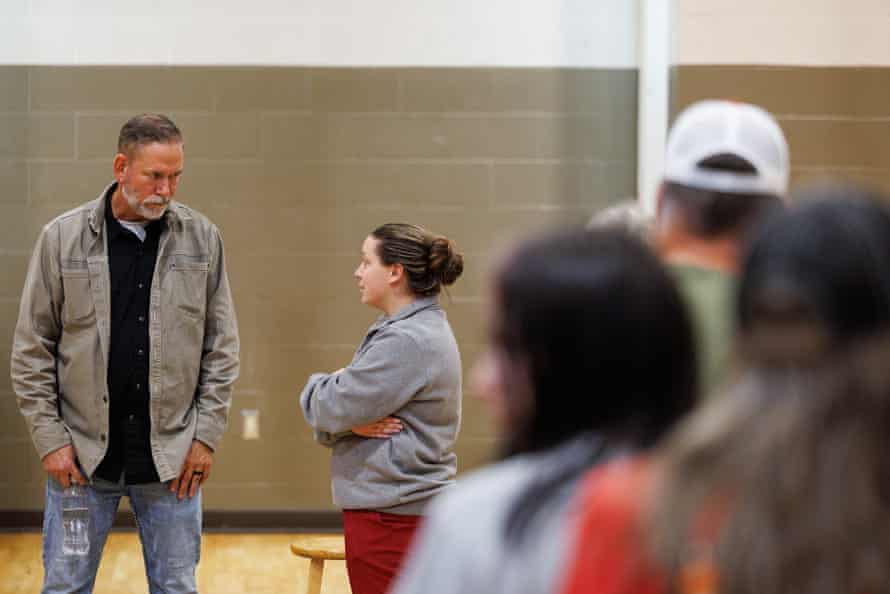
Dan Osborn, an independent candidate for the US Senate in Nebraska, talks with attendees following a town hall meeting in Red Cloud on October 1, 2026.
The candidates are reviving a political approach commonly described as prairie populism, drawing on a tradition of Midwestern politics that brought farmers and workers together against powerful corporate interests. Their campaigns are built around concerns about the cost of living, healthcare access, affordable housing, agricultural pressures and the influence of large corporations.
Among those pursuing this strategy are independent US Senate candidate Dan Osborn in Nebraska, Democratic Senate candidate Josh Turek in Iowa and Democratic congressional candidate Sam Forstag in Montana. Although their political affiliations and individual platforms differ, they share an emphasis on working-class interests and a willingness to campaign in communities that national political organisations have often struggled to reach.
Their efforts come as Democrats and independents look for opportunities to challenge Republican strength in rural states, where support for the party has grown over the past decade.
NEBRASKA INDEPENDENT TAKES CAMPAIGN TO RURAL COMMUNITIES
Osborn, a former union leader running for the US Senate as a nonpartisan candidate in Nebraska, has made extensive travel across the state a central part of his campaign.
He is working to visit all 93 Nebraska counties before election day, including places where Republican candidates traditionally enjoy strong support. At the time of his recent visit to Arthur, a small community of approximately 100 residents, he had around a dozen counties left to cover.
During the visit, Osborn moved between local businesses and met residents in an effort to introduce himself to voters who might otherwise have little direct contact with a Senate candidate.
His campaign centres on workers’ interests, opposition to corruption and a challenge to the dominance of the two major political parties. He argues that political representatives should prioritise ordinary people rather than powerful interests or wealthy donors.
Osborn’s strategy reflects the difficulties independent candidates face in states where party loyalty can strongly influence voting decisions. He believes winning over Republican-leaning voters requires personal engagement and opportunities for residents to assess his positions beyond campaign advertisements.
He reportedly holds five or six town hall meetings on some campaign days, travelling across the state to answer questions and engage with voters, including those who disagree with him.
The candidate has also acknowledged that the Senate contest could be decided by a relatively small number of votes, making individual conversations potentially significant.
ECONOMIC PRESSURES CREATE AN OPENING FOR POPULIST POLITICS
The candidates’ renewed focus on rural communities is closely connected to the economic pressures confronting residents across the region.
Higher fuel costs, tariffs, difficulties accessing healthcare and concerns about rural hospitals have become important issues in their campaigns. Candidates are also addressing affordable housing, wages, public services and the future of small family farms.
Former North Dakota senator Heidi Heitkamp, a Democrat who won statewide election in 2012 before losing her re-election bid in 2018, believes her party weakened its position in rural America by concentrating more heavily on expanding support in suburban communities.
That shift helped leave parts of the rural electorate increasingly receptive to Republican candidates.
Heitkamp argues that politicians seeking to regain support must demonstrate that they understand the practical challenges facing residents, particularly in places where driving long distances is essential for work, healthcare and everyday activities.
For rural households already facing financial pressure, fuel prices and changes in federal policy can have a direct impact on their ability to maintain their livelihoods.
The political opportunity for Democrats and independents, therefore, depends partly on whether they can convince voters that their proposals address these concerns more effectively than those of their opponents.
IOWA CANDIDATE PROMISES REGULAR CONTACT WITH EVERY COUNTY
In Iowa, Democratic Senate candidate Josh Turek is also embracing the prairie populist approach.
Turek describes himself as a common-sense prairie populist and has placed working-class families, rural communities and small businesses at the centre of his political message.
His stated priorities include affordable housing, healthcare, clean drinking water, living wages, public education, reliable infrastructure and action against corruption. He has also raised concerns about the role of money in politics.
Turek has pledged to visit all 99 counties in Iowa every year if elected to the Senate, signalling that he intends to maintain regular contact with communities throughout the state rather than concentrate exclusively on major population centres.
His campaign takes place in a challenging political environment. Turek represents one of the most Republican-leaning districts in the Iowa legislature that Democrats have managed to win, in an area where Donald Trump has secured substantial electoral support.
Nevertheless, Turek says conversations with voters from different political backgrounds have reinforced his belief that economic security and the quality of public services remain important concerns across party lines.
He has encountered Republicans who have supported Trump in multiple elections but who are also worried about healthcare cuts and federal policies affecting their communities.
His strategy is to focus on the people he believes he would represent and to demonstrate that his campaign is committed to addressing their needs.
MONTANA DEMOCRAT TARGETS WORKING-CLASS CONCERNS
Sam Forstag, a Democrat running for Congress in Montana, is another candidate using economic populism to compete in a Republican-leaning area.
A former US Forest Service smokejumper, Forstag has drawn attention to the financial difficulties experienced by working people, including those who have held demanding jobs but still struggled to make ends meet.
His campaign seeks to connect his personal experiences and working background with the concerns of residents who feel that political leaders in Washington are disconnected from ordinary Americans.
Forstag's message is particularly relevant in communities where agriculture and other rural industries face economic uncertainty. Farmers and ranchers have expressed concerns about tariffs, rising costs and the consequences of federal policy.
His campaign is attempting to show voters that economic pressures are not abstract political talking points but challenges affecting families, businesses and local communities.
The broader strategy also reflects an effort by Democratic candidates to compete in districts where Republicans have built strong electoral advantages, rather than concentrating their resources exclusively on traditional Democratic strongholds.
A POLITICAL TRADITION ROOTED IN FARMERS AND WORKERS
The term prairie populism draws on a political tradition that developed in the American Midwest and Great Plains during the late 19th century.
At that time, small farmers faced powerful commercial interests, particularly railway companies that controlled important transportation routes and charged substantial fees to move agricultural products.
Farmers and organised labour groups sought stronger regulation of these interests and greater protection against economic arrangements they believed disadvantaged ordinary producers.
The movement helped establish a tradition of political organising based on rural economic concerns, cooperation among working people and resistance to concentrated corporate power.
Its influence has continued in different forms. North Dakota, for example, has maintained a state-owned bank and a state-run flour mill, while Minnesota has a political tradition reflected in its Democratic-Farmer-Labor Party.
Populist and agriculture-focused Democrats also enjoyed electoral success across the region for decades. Politicians such as Tom Harkin in Iowa, Byron Dorgan in North Dakota, Tom Daschle in South Dakota and Bob Kerrey in Nebraska were prominent figures in that political tradition.
However, Democrats gradually lost ground in many rural areas as Republican support strengthened.
The farm crisis of the 1980s had previously revived economic populism, as poor conditions contributed to the collapse of numerous small farms. Today’s candidates are drawing on similar themes, although the economic and technological challenges facing rural America have changed.
TECHNOLOGY COMPANIES AND DATA CENTRES ENTER THE DEBATE
The current revival of prairie populism extends beyond traditional agricultural issues.
The expansion of data centres and artificial intelligence infrastructure has introduced new questions about corporate influence, land use and the future of rural communities.
For some residents, large technology projects raise concerns about how land and local resources may be used and whether decisions affecting their communities are being made primarily to serve outside corporate interests.
Candidates are increasingly addressing these concerns alongside more familiar issues such as healthcare, employment and the cost of living.
Cory Haala, a history professor at South Dakota State University who studies Midwestern progressive populism, has identified anti-monopoly concerns and debates surrounding data centres as potential focal points for modern populist organising.
The connection is that both historical and contemporary movements question the power of large organisations over communities whose residents feel they have limited influence over important economic decisions.
Nebraska Democratic Party chair Jane Kleeb has also argued that candidates should respond directly to the issues voters raise in their communities instead of relying excessively on political polling to determine their messages.
For candidates seeking support outside traditional party strongholds, the approach offers a way to address local concerns without making every campaign debate a contest over national ideological divisions.
PERSONAL CAMPAIGNING FACES THE TEST OF PARTY LOYALTY
Despite their efforts, the candidates face significant obstacles.
In strongly Republican communities, voting for an independent or Democratic candidate can require voters to reconsider long-standing political loyalties. Direct engagement may help establish trust, but it does not necessarily translate into votes.
Osborn's campaign illustrates that difficulty.
During his visits to small Nebraska communities, he has encountered residents who appreciate his willingness to meet them but remain committed to supporting candidates who align with Trump's policies.
One local Republican leader who met Osborn acknowledged that the candidate had answered questions respectfully but said he would still support the candidate most closely aligned with the president.
The exchange highlights the limits of personal campaigning when political identity remains a major factor in electoral decisions.
Osborn believes that residents must feel comfortable voting outside their usual party preference before an independent candidate can seriously challenge established political loyalties.
For Democratic candidates, the challenge is similar: they must persuade voters that their economic proposals deserve consideration even when those voters disagree with the party on other issues.
ELECTION RESULTS COULD SHAPE FUTURE CAMPAIGNS
The performance of prairie populist candidates could influence how Democrats and independent political organisations approach rural America beyond the 2026 midterm elections.
Strong results, including close contests in traditionally Republican areas, could encourage greater investment in local organising and candidates with established connections to their communities.
Such outcomes would also provide evidence that economic issues and sustained engagement can help candidates compete in places where national party branding has become a disadvantage.
However, the approach remains unproven as a broader electoral strategy. Winning back rural voters will depend not only on campaign visits and economic messaging but also on whether candidates can overcome partisan loyalty and persuade residents that their proposed policies will improve local conditions.
For Osborn, Turek and Forstag, the immediate task is to turn their focus on working people and rural concerns into electoral support.
Their campaigns represent an attempt to rebuild political relationships that have weakened over time. Whether that effort produces significant gains will become clearer when voters cast their ballots in November.