World News
Paris Begins Assessing Damage as Violent Protests Leave Shops Shattered and Streets in Disarray
Paris began assessing the consequences of a night of looting and vandalism on Sunday, 18 October, after violent groups damaged businesses and clashed ...
By Wavers News
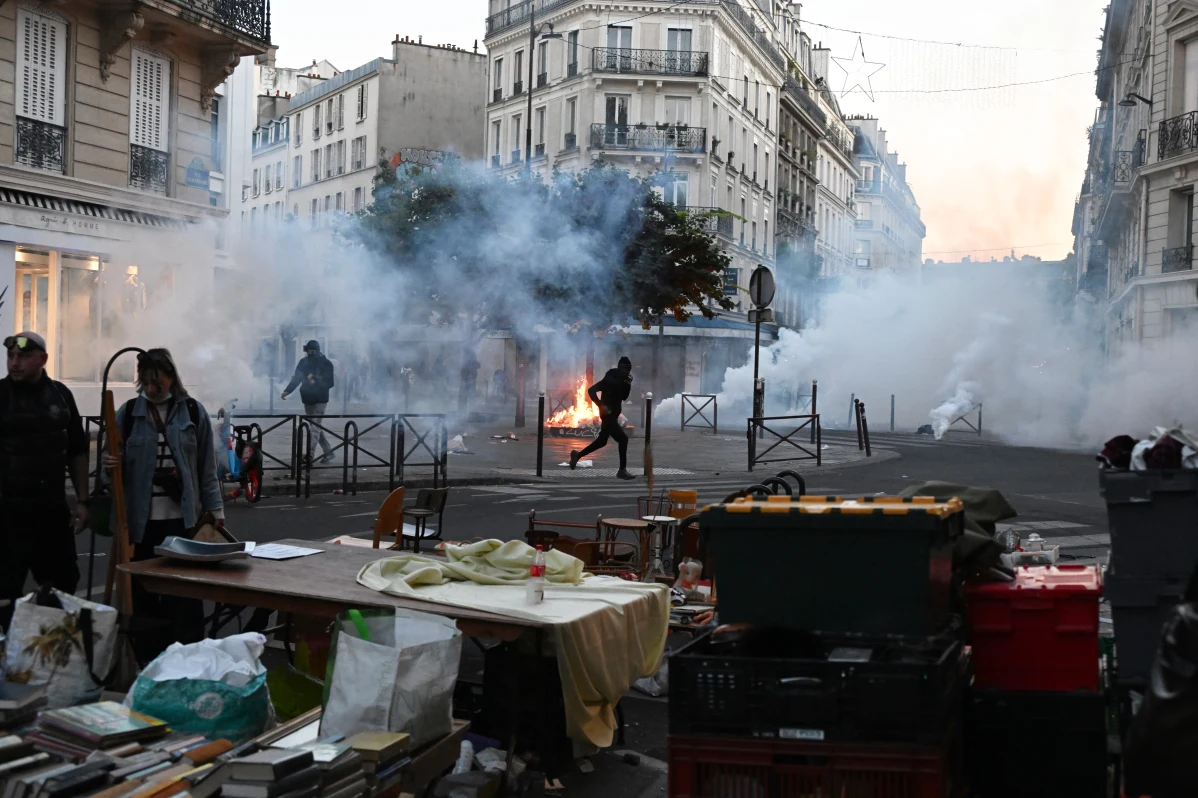
A demonstrator moves through tear gas as protesters clash with police near a flea market in Paris on Sunday, October 18, 2026.
By Sunday morning, broken shop windows, damaged vehicles and debris remained visible around Place de la République and other parts of the French capital. Shopkeepers and repair workers began dealing with the aftermath, while a heavy police presence reflected continuing concerns about further disturbances.
The scenes followed demonstrations held on Saturday, 17 October, which attracted large crowds but were disrupted by groups that targeted commercial premises and public property. The violence created additional difficulties for business owners and residents, many of whom were left to assess the damage in their neighbourhoods.
BUSINESS OWNERS FACE THE AFTERMATH
The damage was particularly visible in several shopping and tourist districts, where storefronts had been smashed and goods stolen during the unrest.
Among those affected were businesses whose premises required urgent repairs before normal trading could resume. Workers began replacing broken glass and securing damaged shopfronts, while some owners faced uncertainty over the financial consequences of the destruction.
Elvire Carles, a perfume shop manager, and Thierry Ménager, an ice cream maker, were among the business owners whose experiences illustrated the difficulties facing traders after the violence.
Repair work also brought back memories of earlier unrest associated with France's Yellow Vest movement, when businesses and public spaces suffered extensive damage during demonstrations.
The consequences extend beyond the immediate cost of replacing windows or repairing buildings. Businesses may also lose trading time while premises are secured and restored, although the total financial losses in Paris were not established in the reporting available.
POLICE REPORT HUNDREDS OF ARRESTS
The unrest continued to affect the capital on Sunday, when demonstrators gathered again around Place de la République.
Police used tear gas as tensions flared, while small groups attempted to set bicycles and rubbish bins on fire. Officers remained deployed around affected areas as authorities sought to prevent further violence.
Paris police reported 855 arrests across the capital region following Saturday's demonstrations. Prosecutors said 557 people remained in police custody at the time of the announcement.
Across France, authorities reported at least 2,400 arrests in connection with the wider unrest, although arrest figures and the number of people remaining in custody represent different measures.
The demonstrations had drawn substantial crowds. Authorities estimated that approximately 550,000 people participated nationwide, while organisers put attendance at around 800,000. The difference reflects separate estimates of the scale of the protests.
PUBLIC ANGER MIXED WITH CONDEMNATION OF VIOLENCE
Reactions among residents reflected disagreement over how the demonstrations had unfolded.
Some people expressed support for the grievances behind the protests but condemned the destruction of businesses and public spaces. Others described feeling frightened by the scale of the disorder.
Jean Foissy, a 74-year-old Paris resident, said he had intended to join the demonstration but returned home after encountering riot police and fires.
Margaux Eude, aged 26, also expressed support for the protest movement while saying she had not expected events to escalate into violence.
Their reactions illustrated a central tension surrounding the demonstrations: support for demands relating to living costs and public services did not necessarily translate into approval of looting and vandalism.
MACRON CONDEMNS THE RIOTING
French President Emmanuel Macron condemned the violence in a televised address on Sunday, saying those responsible for looting and destruction would be held accountable.
He also directed local government representatives to work with mayors to protect businesses and public buildings in the coming weeks. Authorities indicated that restrictions on demonstrations could be imposed where necessary to prevent further disorder.
Interior Minister Laurent Nuñez defended the right to peaceful protest while condemning the violence and attacks on businesses.
The response has also become a source of political disagreement. Opposition figures criticised the government's handling of the unrest, while political leaders debated the reasons behind the demonstrations and the appropriate response.
The mayors of Paris, Marseille and Lyon requested a meeting with Prime Minister Sébastien Lecornu, citing the scale of the damage and the seriousness of the situation.
VIOLENCE REPORTED BEYOND PARIS
Paris was not the only city affected by the demonstrations.
In Marseille, some protesters briefly entered the lobby of the city hall, while a police station was damaged. In Lyon, a fire broke out inside a tourist office.
The most severe damage reported in the coverage occurred in Limoges, in central France, where flames engulfed the historic city hall. The fire caused the building's roof to collapse and severely damaged the structure.
The incidents demonstrated the nationwide scale of the unrest and increased pressure on local authorities to protect public buildings, businesses and residents as recovery efforts began.
Meanwhile, investigations were opened into injuries sustained during the demonstrations, including cases involving a teenage girl who lost an eye in eastern France and a young protester who lost a hand in Saint-Étienne. These cases have added to scrutiny of police tactics and the use of riot-control weapons during demonstrations.
THE CHALLENGE OF RESTORING NORMALITY
As cleanup and repair work continued, Paris faced the immediate task of restoring affected streets and helping businesses secure their premises.
However, the protests also raised wider questions about public dissatisfaction, the cost of living and the condition of public services. Addressing those concerns while preventing further violence will remain a challenge for the French government.
For business owners, the immediate priority is repairing damage and returning to normal operations. For residents, the events have renewed concerns about safety and the impact of unrest on everyday life.
The full financial cost of the damage remains uncertain, and the consequences for businesses and affected communities are likely to become clearer as assessments continue.