World News
Lula Pledges to Defend Democracy After Historic Election Victory Over Flávio Bolsonaro
Brazilian President Luiz Inácio Lula da Silva has vowed to prevent a return to dictatorship and fascism after defeating right-wing challenger Flávio B...
By Wavers News
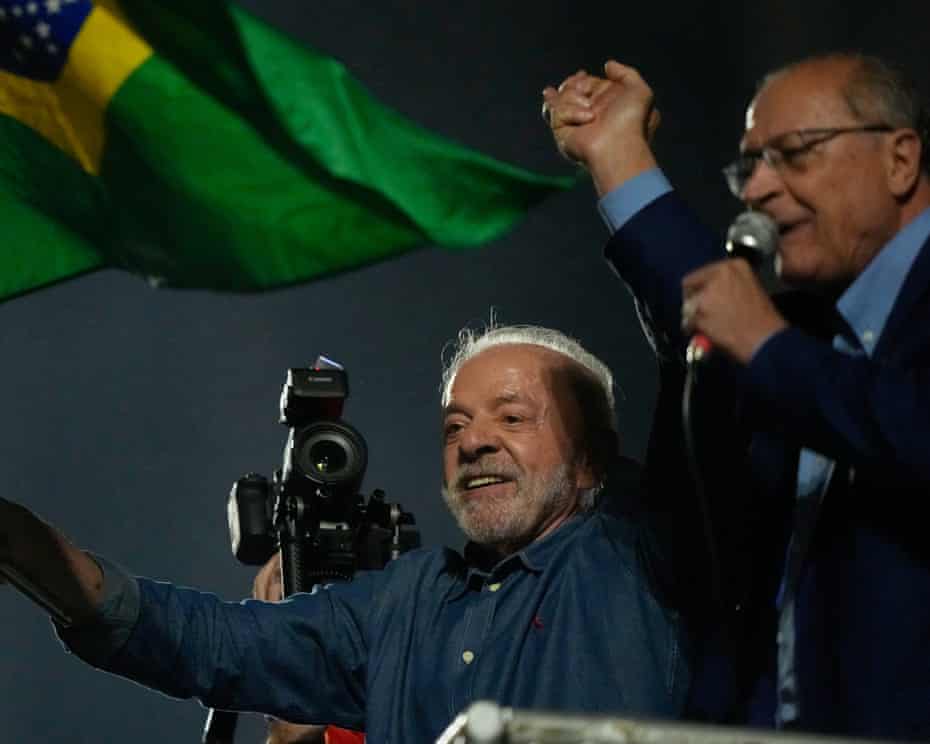
Lula and his running mate, Geraldo Alckmin, address supporters after winning Brazil’s presidential runoff election in São Paulo, Brazil.
Lula won 51.79 per cent of valid votes, receiving 64,256,232 ballots against Bolsonaro’s 59,826,041 votes, representing 48.21 per cent, according to Brazil’s Superior Electoral Court. The result was announced on Sunday, October 25, after a closely watched election that attracted international attention because of its implications for Brazil’s democratic institutions, environmental policies and relations with major global powers.
The 80-year-old president’s victory marked an extraordinary political comeback. After finishing behind Bolsonaro in the first round earlier in October, Lula reversed the result in the decisive vote, becoming the first candidate in Brazil’s modern democratic era to lose the opening round and subsequently win the presidential runoff.
Thousands of supporters gathered in central São Paulo to celebrate the result as Lula addressed the crowd alongside his running mate, Geraldo Alckmin.
Declaring the victory a historic moment for the country, Lula told supporters: “Democracy always, dictatorship never again. Democracy always, fascism never again.”
His remarks reflected the central political message of his campaign, which presented the election as a choice between preserving democratic institutions and returning to the political direction associated with the Bolsonaro family.
The result also interrupted a wider electoral trend that had recently favoured conservative candidates across Latin America, strengthening the position of left-wing political movements in the region.
A HISTORIC COMEBACK AFTER FIRST-ROUND SETBACK
Lula entered the final stage of the election facing considerable uncertainty after failing to finish ahead of Bolsonaro in the first round.
The result initially raised doubts about whether the veteran politician could assemble enough support to secure another term. His challenger, a senator and the son of former Brazilian president Jair Bolsonaro, had mobilised a substantial conservative electorate around his campaign.
The runoff became a decisive test of Lula’s political influence after decades at the centre of Brazilian public life.
In the final days before voting, Lula’s supporters organised large demonstrations in major cities, seeking to mobilise voters and encourage those who had not participated in the first round to return to the polls.
More than one million people gathered at Rio de Janeiro’s Copacabana beach on Saturday, while an even larger crowd was reported along São Paulo’s Paulista Avenue. The demonstrations provided a visible display of support for the incumbent on the eve of the decisive vote.
Students and other anti-Bolsonaro activists also participated in protests during the campaign period, expressing concern about the prospect of another administration led by the Bolsonaro political movement.
When the final results became clear, celebrations spread across São Paulo and other parts of the country. Lula secured more than four million votes more than his opponent and received at least 10 million more votes than he had obtained in the first round.
The outcome established a significant precedent in Brazil’s presidential elections since the restoration of civilian democratic rule following the 1964–1985 military dictatorship.
For Lula, the victory was another major reversal in a political career marked by repeated electoral defeats, periods away from power and a return to the presidency in 2023.
BOLSONARO REJECTS THE ELECTION OUTCOME
Flávio Bolsonaro refused to accept the result after the electoral authorities confirmed Lula’s victory.
The senator expressed anger over his defeat, using the Portuguese word sacanagem to describe the outcome. The expression can convey a sense of unfairness or wrongdoing, depending on the context.
His response echoed the controversy surrounding the 2022 presidential election, when his father, Jair Bolsonaro, refused to concede defeat after losing to Lula.
Jair Bolsonaro was subsequently convicted in connection with a plot to overturn the 2022 election result and is serving a 27-year prison sentence. His political future had been closely tied to his son's presidential campaign, with a Flávio victory expected to offer the family a route back to influence in the federal government.
The younger Bolsonaro’s defeat has therefore dealt a setback to a political movement that remains influential among conservative voters.
During election-night celebrations in São Paulo, some Lula supporters openly mocked Bolsonaro and expressed hope that he would face legal consequences over separate investigations.
Flávio Bolsonaro is facing federal police investigations into suspected wrongdoing, including possible money laundering. The investigations do not establish guilt, and he maintains his innocence.
There has also been speculation that he could leave Brazil for the United States after his Senate term ends in February, when he would lose the parliamentary immunity associated with his position. His future plans have not been established.
Despite Bolsonaro’s rejection of the outcome, the electoral authorities declared Lula the winner based on the official count.
INTERNATIONAL LEADERS CONGRATULATE LULA
Lula’s victory prompted congratulations from political leaders across Latin America, Europe and Asia, reflecting Brazil’s importance as the region’s largest economy and a major participant in international diplomacy.
Mexican President Claudia Sheinbaum celebrated the result, declaring that democracy had prevailed and that the Brazilian people had won.
Spain’s Prime Minister Pedro Sánchez described the result as a sign of a wider resurgence of progressive politics. United Kingdom Foreign Secretary Ed Miliband also welcomed Lula’s victory, highlighting the opportunity for continued cooperation on democracy, social justice and climate action.
The European Commission President, Ursula von der Leyen, said democracy and multilateralism had prevailed in Brazil. China’s foreign ministry said Beijing respected the choice made by Brazilian voters.
Conservative leaders in South America also acknowledged the result despite their ideological differences with Lula.
Chile’s President José Antonio Kast contacted Lula to offer congratulations, while Peru’s President Keiko Fujimori praised the Brazilian people for participating in the democratic process.
The responses demonstrated that Lula’s victory had been recognised across political divisions, even as the election exposed deep disagreements over the direction of Brazil and the wider region.
United States President Donald Trump had not publicly responded at the time covered by the initial reports.
Trump’s administration had been seen as favouring a victory for Flávio Bolsonaro, whose political movement shares ideological connections with the American president’s conservative allies.
Lula’s success therefore represents a setback for efforts to expand that political alliance into Brazil, a country whose diplomatic and economic influence extends well beyond Latin America.
ALLEGATIONS OF US INTERFERENCE BECOME PART OF THE DEBATE
The election took place amid accusations that the United States had attempted to influence Brazil’s political direction through economic and diplomatic pressure.
Those accusations became a prominent part of the reaction following Lula’s victory.
Erika Hilton, a transgender lawmaker who recently became the most-voted woman in Brazil’s Congress, argued that the result demonstrated the limits of foreign pressure on the country’s electorate.
She said Brazil had resisted what she described as interference by a foreign government seeking to treat the country as an extension of its own political influence.
Her remarks reflected a broader argument among Lula’s supporters that Brazilian voters should determine the country’s leadership without outside pressure.
The dispute is significant because relations between Washington and Brasília have been affected by disagreements involving trade, political sovereignty and the legal proceedings against Jair Bolsonaro.
Lula has generally favoured a foreign policy that preserves Brazil’s independence in international affairs while maintaining relations with a wide range of countries, including China and other members of the BRICS grouping.
A Bolsonaro-led administration would have been expected to pursue closer ideological alignment with Trump’s political agenda.
Lula’s re-election means Brazil is likely to continue seeking an independent diplomatic position, although the practical direction of relations with Washington will also depend on economic interests and negotiations between the two governments.
The allegations of interference remain part of the political dispute surrounding the election; they should not be treated as proof that the United States altered the result.
AMAZON RAINFOREST AND INDIGENOUS COMMUNITIES AT STAKE
Environmental protection is expected to remain one of the most consequential areas of policy following Lula’s victory.
Brazil contains most of the Amazon rainforest, an ecosystem that plays an important role in global climate regulation and supports numerous Indigenous communities and other populations.
During his current presidency, Lula has sought to strengthen environmental enforcement and reduce deforestation. His government’s approach has differed from that of Jair Bolsonaro, whose 2019–2022 administration faced extensive criticism over rising deforestation and the weakening of environmental protections.
Former environment minister Marina Silva had warned before the runoff that a victory for Flávio Bolsonaro could lead to further destruction of the rainforest and a renewed threat to Indigenous territories.
Following Lula’s win, Silva welcomed the result and expressed relief that Indigenous communities would be less exposed to the risks she associated with another Bolsonaro administration.
She had previously warned about the possibility of Indigenous territories being invaded and illegal miners returning to areas where communities depend on their land for their livelihoods and cultural survival.
Lula’s victory gives his administration an opportunity to continue its environmental agenda, including efforts to combat illegal mining and protect forests.
The result does not guarantee that these challenges will disappear. Illegal activities, land disputes and pressure from commercial interests remain difficult problems, and effective enforcement will require sustained government action.
Nevertheless, the election has preserved the current administration’s direction on environmental policy at a time when the future of the Amazon remains an international concern.
A DEFEAT FOR THE BOLSONARO FAMILY'S POLITICAL AMBITIONS
The election result represents a major setback for the Bolsonaro family, which has maintained a strong political following among conservative Brazilians.
Flávio Bolsonaro campaigned as the candidate capable of continuing his father's political legacy and challenging Lula's government.
His campaign drew on conservative positions concerning public security, social issues and the role of government. It also benefited from voters dissatisfied with the Workers' Party and those who remained loyal to the former president.
The defeat leaves questions about how the movement will maintain its influence and who could lead it in future elections.
Jair Bolsonaro remains a prominent figure among his supporters despite his conviction and imprisonment. His political standing has helped sustain his family's influence, but the presidential result shows that the movement could not secure enough votes to return to power through his son.
The election-night atmosphere in Brasília, where Flávio Bolsonaro watched the count with allies, reportedly became increasingly sombre as Lula's lead widened.
Some guests left before Bolsonaro addressed the result. Meanwhile, supporters of the incumbent celebrated on São Paulo's streets, with some using costumes and images to mock the defeated candidate.
The contrasting scenes illustrated the sharp political divide that continues to shape Brazil.
LULA FACES THE CHALLENGE OF GOVERNING A DIVIDED COUNTRY
Although the election has given Lula another presidential mandate, the result leaves him facing the challenge of governing a country in which millions of voters backed his opponent.
Bolsonaro received nearly 60 million votes, demonstrating the continuing strength of the conservative movement and the limits of Lula's appeal among parts of the electorate.
The president will need to address concerns involving household finances, public services, security and economic opportunities while seeking to maintain the support of the voters who returned him to office.
His government has emphasised poverty reduction, access to healthcare and education, social protection and environmental conservation. These priorities helped define his political identity during his earlier presidencies and have remained central to his current administration.
At the same time, Brazil's political divisions will make consensus difficult. Many conservative voters remain sceptical of the Workers' Party, while Lula's supporters see his re-election as an opportunity to protect social programmes and democratic institutions.
The close result means the president will have to balance the expectations of his political base with the need to respond to concerns shared by voters across party lines.
His next term will also be shaped by Brazil's Congress, where conservative lawmakers retain substantial influence. That political balance could complicate efforts to pass legislation and implement parts of his programme.
The outcome of the election has settled the question of who will lead Brazil, but it has not resolved the disagreements over the country's economic, social and political future.
A LANDMARK MOMENT FOR BRAZILIAN DEMOCRACY
Lula's fourth presidential victory marks another extraordinary chapter in a political career that began in Brazil's labour movement.
Born into poverty, he became a metalworker and trade union leader before entering national politics. He lost presidential elections in 1989, 1994 and 1998 before winning in 2002 and serving two consecutive terms.
After leaving office, he later returned to the political stage and defeated Jair Bolsonaro in the 2022 election, beginning his current presidency in 2023.
His latest victory adds to that history and gives him another opportunity to shape Brazil's domestic and international policies.
For supporters, the result represents a defence of democracy, social protections and environmental responsibility. For Bolsonaro's supporters, the defeat leaves a movement with a substantial electoral base outside the presidency and facing an uncertain political future.
Lula's declaration that democracy must prevail over dictatorship and fascism captured the significance he attaches to the result.
The coming term will test whether his administration can translate that electoral victory into effective governance, address the country's divisions and maintain the confidence of voters who expect tangible improvements in their daily lives.
For Brazil, the election has produced a historic outcome. The task ahead is to turn that outcome into lasting democratic stability.