World News
G20 Foreign Ministers Divided Over Ukraine War as Rubio Cancels Group Photograph Amid Russia Dispute
A meeting of foreign ministers from the Group of 20 (G20) major economies has exposed deep divisions over global security, Russia's war against Ukrain...
By Wavers News
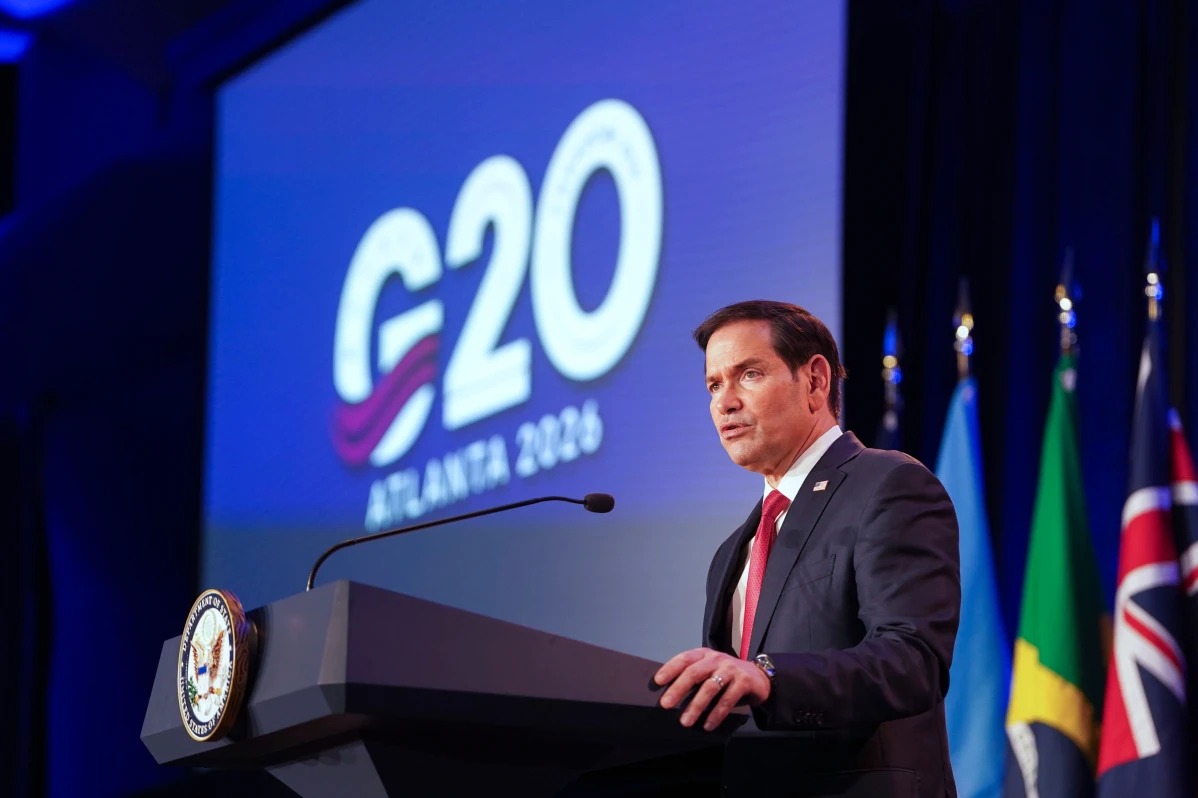
US Secretary of State Marco Rubio, alongside Polish Foreign Minister Radosław Sikorski and African Union Executive Council Chair Edouard Bizimana, attends the opening session of the G20 Foreign Ministers' Meeting in Atlanta, Georgia, on October 30, 2026.
The two-day diplomatic gathering, which began in Atlanta, Georgia, on Friday, October 30, 2026, brought together senior representatives from major economies to discuss international security, trade, energy supplies and freedom of navigation.
US Secretary of State Marco Rubio, who hosted the meeting under the American presidency of the G20, cancelled the customary photograph after European diplomats threatened to boycott the session or walk away if Russian Foreign Minister Sergey Lavrov participated.
The disagreement highlighted the difficulty of achieving a common position among countries whose interests and foreign policy priorities have increasingly diverged.
Despite the tensions, Rubio urged participating governments to cooperate, warning that the world was facing interconnected economic and geopolitical crises capable of threatening international stability.
RUSSIA'S PARTICIPATION TRIGGERS DIPLOMATIC TENSIONS
The presence of Lavrov became one of the most contentious issues surrounding the meeting, particularly among European representatives who have strongly opposed Moscow's invasion of Ukraine.
Several European officials objected to being photographed alongside the Russian foreign minister, arguing that such an appearance could create an impression of normal diplomatic relations with Moscow despite its continuing military campaign in Ukraine.
Polish Deputy Prime Minister and Foreign Minister Radosław Sikorski was among those expressing opposition to the arrangement.
Speaking ahead of the discussions, Sikorski indicated that he was not alone in refusing to appear in a photograph with Lavrov.
German Foreign Minister Johann Wadephul also maintained that relations with Russia could not be treated as normal while the war continued.
British Foreign Secretary Ed Miliband used his remarks to stress the importance of securing a just and lasting peace in Ukraine, arguing that Russia's actions challenged international law, national sovereignty and the right of countries to determine their own futures.
Faced with the possibility of a public diplomatic confrontation, Rubio decided to abandon the photograph rather than allow the disagreement to overshadow the meeting.
The decision did not resolve the underlying tensions, which continued during discussions involving representatives from Russia, European countries and other G20 members.
RUSSIA REJECTS UKRAINE'S POSITION AND POLAND'S G20 AMBITIONS
Lavrov defended Moscow's position on the war, arguing that Russia would not accept circumstances in which Ukraine posed what he described as a military threat to legitimate Russian security interests.
He also criticised Ukrainian President Volodymyr Zelenskyy's position on long-range strikes against Russian territory, saying it was not helpful to preparations for proposed discussions between Russia, Ukraine and the United States.
The Russian foreign minister also opposed Poland's participation in the G20, questioning the country's relevance to the grouping and arguing that its involvement violated diplomatic principles.
Poland attended the Atlanta meeting as a guest for the first time and has been seeking full G20 membership with support from the United States.
The disagreement is particularly significant because Poland is one of Ukraine's strongest European allies and has played an important role in supporting Kyiv since Russia launched its full-scale invasion in February 2022.
Sikorski acknowledged that reaching agreement would be difficult when countries involved in ongoing wars were represented at the same diplomatic table.
NO JOINT COMMUNIQUÉ EXPECTED FROM THE MEETING
The disagreements over Russia, Ukraine and other international issues have made it unlikely that the foreign ministers will produce a joint communiqué at the conclusion of their discussions.
Instead, the United States is expected to issue a chair's statement outlining the discussions and major issues raised during the gathering.
The divisions extend beyond the Russia-Ukraine war to include the US-Israeli war against Iran, American trade tariffs, China's activities in the South China Sea and disagreements over the participation of certain countries.
Diplomats who attended the opening discussions described the atmosphere as cordial despite the political differences.
Participants also indicated that they remained committed to working towards a successful G20 leaders' summit scheduled for December in Florida, which will be hosted by US President Donald Trump.
The absence of a joint statement reflects the difficulty of securing unanimous agreement among countries with conflicting political, economic and security interests.
UKRAINE AND SOUTH AFRICA ABSENT FROM THE GATHERING
Ukraine, despite being central to discussions surrounding European security, was not invited to the Atlanta foreign ministers' meeting.
US officials said the decision was based on their intention to invite only formal G20 members.
Poland's attendance as a guest was linked to its interest in joining the grouping.
South Africa, a founding G20 member and the only African country in the organisation, was also excluded from the meeting despite its formal membership.
The decision has generated criticism from other participating countries, some of which expressed reservations about Washington's handling of the invitation process.
South African Foreign Minister Ronald Lamola did not attend the gathering.
A spokesperson for the minister, Phindile Kunene, said the country's absence was not voluntary and welcomed support from G20 members that had questioned its exclusion.
South Africa also indicated its willingness to participate in future meetings on equal terms when the United Kingdom assumes the G20 presidency next year.
The exclusion is particularly sensitive because South Africa hosted the G20 during the previous year, when senior American officials, including Trump and Rubio, declined to participate in some of the meetings organised under its presidency.
US APPROVES $2.1 BILLION PATRIOT MISSILE SALE FOR UKRAINE
The diplomatic tensions unfolded as the United States announced approval of a proposed $2.1 billion sale of Patriot air defence interceptors for Ukraine.
The approval came amid concerns over Washington's recent approach to the war, including decisions involving sanctions against Russia and temporary restrictions on logistical and intelligence assistance to Kyiv.
The Patriot system is an advanced air defence platform designed to intercept incoming ballistic and cruise missiles as well as aircraft.
The proposed sale represents an important development in Ukraine's efforts to strengthen its ability to defend against Russian attacks.
The announcement also comes as diplomatic efforts continue to explore the possibility of direct discussions involving Russia, Ukraine and the United States.
IRAN WAR AND FREEDOM OF NAVIGATION DOMINATE SECURITY CONCERNS
Beyond Ukraine, the conflict involving Iran and the wider Middle East remained a major issue during the G20 discussions.
The United States identified freedom of navigation as one of the central subjects for the meeting, particularly in strategically important waterways, including the Strait of Hormuz, the Red Sea, the Black Sea and the South China Sea.
These routes are essential to international trade, energy transportation and the movement of commercial vessels.
Disruptions in these areas could increase shipping costs, threaten energy supplies and create further uncertainty for the global economy.
The possibility of renewed US military action against Iran also heightened concerns among participating countries, particularly those in the Middle East.
Rubio held separate discussions with Saudi Foreign Minister Prince Faisal bin Farhan and Turkish Foreign Minister Hakan Fidan on the sidelines of the meeting.
Saudi Arabia has a significant interest in regional stability, while Türkiye has played a diplomatic role in efforts to manage tensions involving Iran and other countries.
The possibility of further military strikes and potential Iranian retaliation against regional allies has added urgency to discussions about maritime security and the wider consequences of the conflict.
RUBIO CALLS FOR COOPERATION AMID GLOBAL UNCERTAINTY
Opening the meeting, Rubio warned that the international community was confronting several interconnected crises affecting economic stability and international security.
He highlighted disruptions to global energy and food supplies, international trade and freedom of navigation, describing them as serious threats to the foundations of the global economic system.
The US secretary of state urged fellow ministers to coordinate their responses to emerging challenges and protect shared international interests.
The Atlanta meeting has demonstrated the difficulties facing the G20 as major powers attempt to address global challenges while maintaining sharply different positions on ongoing conflicts.
With no broad agreement expected from the foreign ministers, attention is now turning towards the December leaders' summit in Florida, where heads of government will face similar disagreements over security, trade and international cooperation.