News
FG Challenges World Bank's Assessment of Nigeria's ₦7.7 Trillion Interest Payments
The Federal Government has challenged concerns raised about Nigeria's debt burden, arguing that the country's financial position is improving despite ...
By Patience
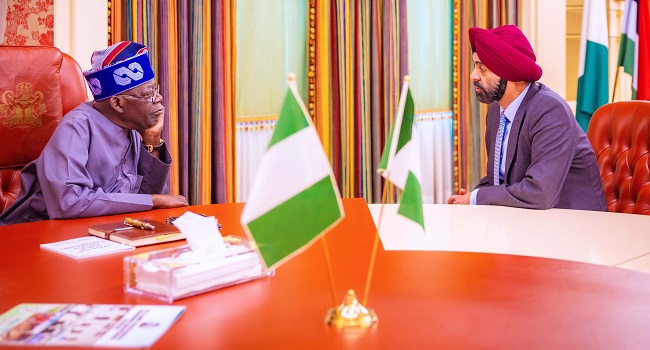
President Bola Tinubu meets with World Bank President Ajay Banga at the Presidential Villa in Abuja.
The Ministry of Finance said the figures used to assess the government's debt obligations did not present a complete picture of federal revenue and therefore gave a misleading impression of the country's ability to meet its financial commitments.
The disagreement followed an assessment by the World Bank, which reported that Nigeria's interest payments amounted to 124 per cent of federal revenue between January and June 2026.
In its response, the ministry maintained that government revenue was growing faster than interest costs, pointing to improvements recorded over the same period in the previous year.
The exchange has renewed attention on Nigeria's public finances, particularly the relationship between government revenue, debt obligations and the resources available for public services and development projects.
FG QUESTIONS HOW THE DEBT FIGURES WERE CALCULATED
The Ministry of Finance argued that the reported debt-to-revenue ratio did not adequately account for the different levels of government involved in borrowing and repayment.
According to the ministry, the ₦7.7 trillion interest figure included obligations that the Federal Government services on behalf of other tiers of government, including external loans taken by state governments.
Comparing those combined interest payments solely against federal revenue, it argued, produces a distorted picture because the two figures do not cover the same level of government.
The ministry also said the revenue figure used in the assessment excluded some income earned by government agencies and public enterprises that had not yet been transferred to the Treasury.
It maintained that these factors should be considered when evaluating the country's ability to meet its debt obligations.
The government did not dispute the reported ₦7.7 trillion in interest payments. Instead, its response focused on how the payments were measured against revenue and whether the resulting ratio accurately represented the country's overall fiscal position.
GOVERNMENT POINTS TO GROWTH IN REVENUE
To support its position, the ministry compared Nigeria's financial performance in the first halves of 2025 and 2026.
According to the figures released by the government, federal revenue increased from ₦3.6 trillion in the first half of 2025 to ₦6.2 trillion during the corresponding period in 2026.
This represented a growth of approximately 72 per cent.
Interest payments also increased, rising from ₦5.6 trillion to ₦7.7 trillion over the same period, an increase of about 38 per cent.
The ministry argued that the difference between these growth rates showed that revenue was expanding more rapidly than interest costs.
It also said the interest-to-revenue ratio had fallen from 156 per cent in the first half of 2025 to 124 per cent in the first half of 2026.
The government described the figures as evidence of progress under its economic reforms.
However, the reported reduction in the ratio does not mean interest payments have fallen in absolute terms. The figures show that the amount paid in interest increased even as revenue grew at a faster rate.
WHY THE TIMING OF REVENUE MATTERS
Another point raised by the Ministry of Finance concerns the timing of revenue collection.
The ministry said some taxes are collected predominantly during the second half of the year because of statutory payment schedules.
As a result, it argued that using only the first six months of revenue to assess a full year's debt obligations could produce an incomplete picture of the government's financial position.
The ministry cited the difference between the first-half figures for 2025 and the full-year outcome as an example.
According to its statement, the debt-service-to-revenue ratio stood at 156 per cent in the first half of 2025, while the full-year ratio fell below 60 per cent.
The government said this supported its position that a six-month assessment should not automatically be treated as a complete measure of annual debt sustainability.
Nevertheless, the figures cover different reporting periods, meaning the first-half and full-year ratios should not be interpreted as directly equivalent measurements. A complete assessment requires consideration of the full year's revenue, interest payments and principal repayments.
WORLD BANK'S ASSESSMENT RAISES DEBT SUSTAINABILITY CONCERNS
The World Bank's concern centres on the proportion of government revenue being consumed by interest payments.
When a large share of revenue goes towards servicing debt, the government has less money available for other responsibilities, including infrastructure, education, healthcare and security.
High interest costs can also make public finances more vulnerable to unexpected economic pressures, especially when revenue falls short of expectations.
Nigeria has been pursuing reforms intended to improve revenue generation and strengthen public finances. However, the impact of those reforms must be assessed alongside the country's borrowing requirements and the cost of existing obligations.
The Federal Government maintains that its revenue performance is improving and that the figures should be interpreted within the appropriate fiscal context.
The disagreement highlights the importance of transparent reporting and consistent methods when assessing the country's debt position.
FG CITES FULL-YEAR FORECAST
The ministry also pointed to the World Bank's projection for Nigeria's full-year 2026 debt-service-to-revenue ratio.
According to the government, the bank projected that total debt service, including both interest and principal repayments, would account for 46 per cent of revenue for the year.
The ministry described this as a more appropriate benchmark for evaluating the country's debt obligations than a ratio calculated from the first six months alone.
However, the 46 per cent figure is a projection rather than a confirmed full-year result. The actual outcome will depend on revenue collection and debt-service payments throughout the remainder of 2026.
The distinction matters because interest payments represent only one component of debt service. Principal repayments must also be considered when assessing the overall amount the government needs to pay.
The ministry said the government's borrowing remained within limits approved by the National Assembly under the 2026 Appropriation Act and the approved borrowing plan.
It also stated that borrowing was being conducted in accordance with Nigeria's Fiscal Responsibility Act and the legislation governing the Debt Management Office.
WHAT THE DISAGREEMENT MEANS FOR NIGERIA
The debate between the Federal Government and the World Bank underscores the continuing challenge of balancing debt obligations with the need to finance national development.
Although the government has highlighted rising revenue and a declining first-half interest-to-revenue ratio, the ₦7.7 trillion spent on interest payments remains a significant financial commitment.
The key question is whether revenue growth can be sustained sufficiently to reduce pressure on public finances while allowing the government to meet its other obligations.
The final picture for 2026 will become clearer when full-year revenue and debt-service figures are available.
Until then, the government and independent analysts will continue to assess the country's financial position using available data, different reporting periods and projections for the remainder of the year.