Business
Chinese-Owned Cobalt Mine Faces $6.3 Million Lawsuit as 27 Congolese Residents Allege Environmental Pollution
Twenty-seven residents living near a major copper and cobalt mining operation in the Democratic Republic of the Congo (DRC) have taken legal action ag...
By Patience
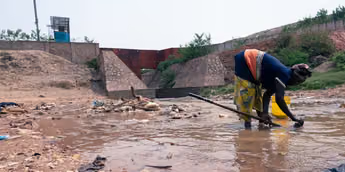
A resident stands in a shallow stream in the DRC, Africa. PC: RAID/Lydia Katanga
The lawsuit, filed at the Commercial Court in Kolwezi on November 3, 2026, targets Compagnie Minière de Musonoie Global (COMMUS), a mining company majority-owned by Chinese mining giant Zijin Mining.
The claimants, including eight children, allege that mining activities have contributed to air, water and soil contamination, exposing nearby residents to environmental hazards and threatening their health and livelihoods.
They are seeking approximately $1.3 million in compensation for the alleged harm and another $5 million to support the restoration of the affected environment.
The legal action is supported by RAID, a UK-based corporate accountability organisation, and AFREWATCH, a Congolese non-profit organisation working on environmental and human rights issues.
RESIDENTS SEEK COMPENSATION AND ENVIRONMENTAL RESTORATION
The affected residents are demanding more than financial compensation.
They want the mining company to address the alleged contamination, restore damaged land and water sources, and take measures to prevent further environmental harm.
Their demands also include access to safe drinking water and an independent assessment of the potential health consequences for people living around the mining operation.
The claimants argue that communities should not bear the environmental and health costs associated with industrial mining while valuable minerals are extracted for international markets.
The lawsuit also seeks to establish accountability for the alleged failure to adequately protect residents from pollution.
SCIENTIFIC STUDIES FORM PART OF THE LEGAL CASE
The legal action draws on scientific investigations commissioned by RAID and AFREWATCH to examine environmental conditions around the COMMUS mining operation.
The studies reportedly identified elevated concentrations of fine particulate matter in the air near the mine, alongside evidence of water contamination in a community well close to its tailings storage facility.
Fine particulate pollution is a concern because small airborne particles can enter the respiratory system and contribute to health problems, particularly among children and people with existing respiratory conditions.
The investigations also identified highly acidic water and elevated concentrations of certain metals in the sampled water.
RAID and AFREWATCH say the findings support the residents' concerns about the environmental impact of mining activities.
The allegations have not yet been established by a court, and the findings cited by the organisations do not, on their own, determine the mining company's legal responsibility.
ZIJIN MINING OWNS MAJORITY STAKE IN COMMUS
COMMUS operates a copper and cobalt mine in Kolwezi, a major mining centre in the mineral-rich Lualaba Province of the Democratic Republic of the Congo.
The company is 67 per cent owned by China's Zijin Mining Group, while Congolese state-owned mining company Gécamines holds a 28 per cent stake. The Congolese government owns the remaining five per cent.
According to company information, the operation has an annual production capacity exceeding 120,000 metric tonnes of copper and 2,000 tonnes of cobalt.
Zijin Mining is an international mining group with interests in several mineral resources, including copper, gold and other metals.
COMMUS has said it intends to contest the allegations presented in the lawsuit.
The company told Reuters that it takes its responsibilities towards local communities and the environment seriously.
In an earlier response to concerns raised by RAID and AFREWATCH, COMMUS maintained that its operations comply with Congolese environmental regulations and that its own monitoring indicated air quality generally met applicable standards.
It also argued that pollution in the Kolwezi area could have multiple sources, including natural geological conditions, historical mining activities and other industrial operations.
CONGOLESE GOVERNMENT AND ENVIRONMENTAL REGULATOR ALSO NAMED
The lawsuit extends beyond the mining company, naming the Congolese state and the country's environmental regulator, known as ACE.
The claimants accuse the government and the regulator of failing to adequately monitor the mining operation and enforce environmental protection requirements.
They argue that stronger oversight could have helped prevent or address the environmental problems they say have affected their communities.
The country's Mines Ministry and ACE had not immediately responded to requests for comment on the legal action.
The Commercial Court in Kolwezi had also not provided the requested case documents at the time the lawsuit was reported.
CONGO'S MINING LAWS COULD PROVE IMPORTANT
The case could test the application of the Democratic Republic of the Congo's environmental protection provisions under its 2018 Mining Code.
The legislation provides for mining companies to be held responsible for environmental damage associated with their operations unless they can demonstrate that the damage resulted from factors unrelated to their activities.
This legal framework could become significant as the court examines the evidence presented by the residents and the mining company's response.
RAID and AFREWATCH believe a successful outcome could create an important precedent for other communities living near industrial mining operations.
The organisations say the case could provide a pathway for residents affected by alleged mining pollution to seek compensation and demand environmental restoration through the courts.
LEGAL ACTION HIGHLIGHTS ENVIRONMENTAL CHALLENGES IN GLOBAL MINERAL SUPPLY
The lawsuit comes as the Democratic Republic of the Congo maintains its position as the world's largest producer of cobalt and the second-largest producer of copper.
Both minerals are important to global industries. Cobalt is widely used in rechargeable batteries, while copper plays a major role in electricity networks, construction, electronics and renewable energy infrastructure.
The country's mineral wealth has attracted substantial international investment, particularly from Chinese mining companies seeking access to strategic resources.
The legal action in Kolwezi highlights the environmental concerns surrounding mineral extraction and the responsibilities of companies operating in communities close to mining sites.
For the 27 residents involved, the immediate objective is to obtain compensation for the harm they allege and secure the restoration of their surrounding environment.
The court proceedings will determine how the claims are examined and whether the mining company and the other defendants can be held legally responsible.