Business
China’s Economic Recovery Faces Fresh Concerns Despite 4.5% Growth
China’s economic recovery remains vulnerable despite an improvement in growth during the third quarter of 2026, with a senior economic official warnin...
By Wavers News
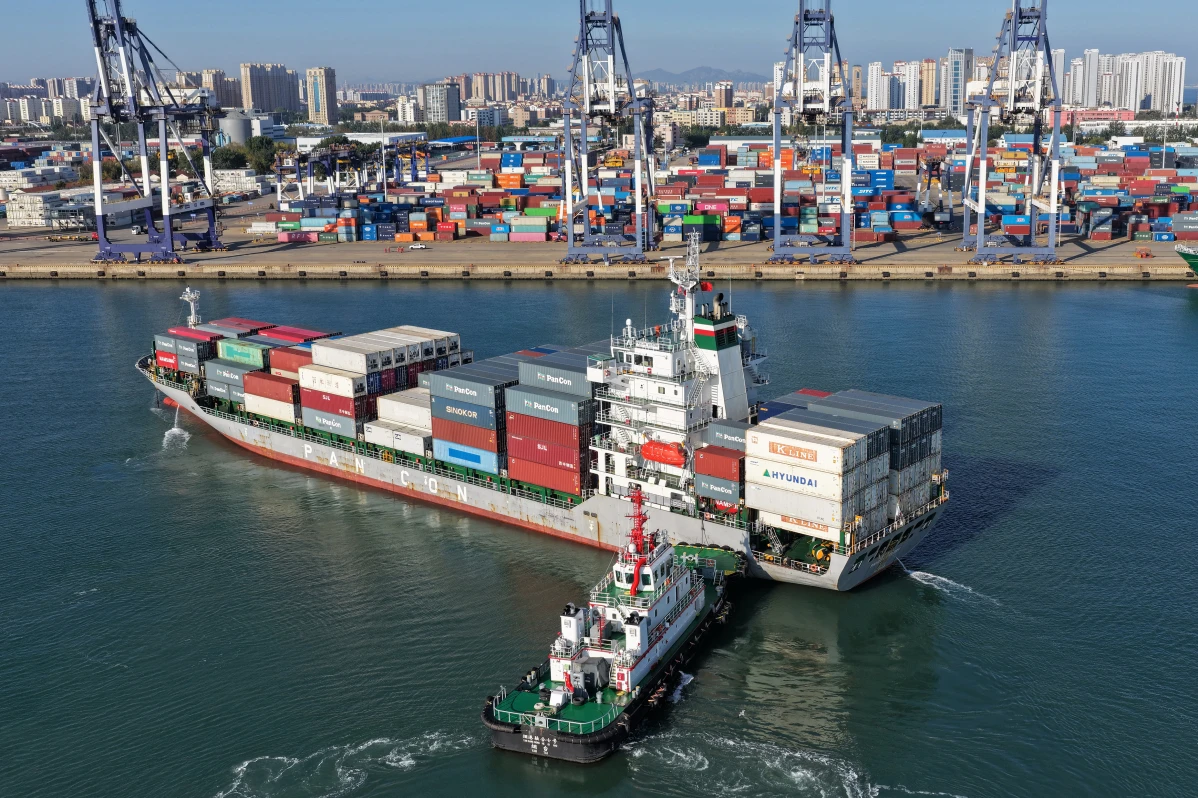
A tugboat guides a container ship towards a port in Yantai, Shandong Province, eastern China, on October 14, 2026.
Zuo Gang, deputy director of the Department of National Economic Comprehensive Affairs at China’s National Development and Reform Commission (NDRC), gave the assessment on Tuesday, October 20, as authorities considered measures to strengthen economic activity in the world’s second-largest economy.
His comments came a day after official figures showed that China’s gross domestic product (GDP) grew by 4.5 per cent year-on-year between July and September, accelerating from 4.3 per cent in the second quarter.
The improvement exceeded market expectations, but the latest figures have not removed concerns about the uneven nature of the recovery, particularly the contrast between strong export performance and subdued spending at home.
EXPORT PERFORMANCE SUPPORTS ECONOMIC GROWTH
China’s export sector has remained an important source of economic growth, helping manufacturers sustain production despite continuing weakness in domestic demand.
The third-quarter figures showed that economic growth had regained some momentum after slowing to 4.3 per cent in the April-to-June period. However, the improvement has not been matched by equally strong performance across all areas of the economy.
Zuo warned that the effects of external shocks were becoming more pronounced, while the imbalance between strong supply and weak domestic demand remained significant.
His assessment points to a challenge for Chinese policymakers: maintaining industrial output and export activity while encouraging households and businesses to spend more within the domestic economy.
Although international demand has helped sustain production, reliance on overseas markets leaves China exposed to changes in global trade conditions, economic uncertainty and potential restrictions affecting its exports.
WEAK CONSUMER SPENDING REMAINS A CONCERN
The latest economic data also highlight the difficulties facing China’s domestic consumption sector.
Retail sales, a key measure of consumer spending, increased by 1.1 per cent year-on-year in September. Although this represented an improvement from August, the pace of growth remained modest.
The figures suggest that households are still cautious about spending, limiting the extent to which consumer demand can support a broader economic recovery.
Weak domestic demand is particularly significant because Chinese authorities have been seeking to strengthen consumption as a more sustainable source of growth, rather than relying heavily on manufacturing and exports.
The property sector has also remained under pressure. Fixed-asset investment fell by 7.2 per cent during the first nine months of 2026 compared with the same period a year earlier, while property investment declined by 20.6 per cent.
The continued contraction in investment, particularly in real estate, adds to the challenges facing businesses and policymakers as they attempt to improve confidence and strengthen economic activity.
GOVERNMENT PREPARES FIVE-YEAR DOMESTIC DEMAND PLAN
In response to these challenges, China’s National Development and Reform Commission is preparing an implementation plan for the country’s 2026–2030 strategy to expand domestic demand.
Zuo said authorities would accelerate efforts to finalise and implement the plan, signalling that strengthening demand at home remains a policy priority.
The initiative is intended to address the imbalance between production and consumption and support more sustainable economic expansion.
Its implementation will be important as officials seek to encourage stronger domestic spending while managing external economic pressures.
However, the announcement did not establish how quickly the proposed measures would produce results or how significantly they would change consumer behaviour.
The effectiveness of the strategy will depend partly on whether households and businesses become more willing to spend and invest, as well as on the broader economic conditions affecting employment, income and confidence.
CHINA REMAINS UNDER PRESSURE TO SUSTAIN GROWTH
China’s economy grew by 4.6 per cent during the first nine months of 2026 compared with the corresponding period in 2025, keeping the country near the lower end of its official annual growth target of 4.5 to 5 per cent.
The latest quarterly improvement therefore provides some support for the government’s growth objective, but the underlying weaknesses remain significant.
The divergence between export-oriented industries and domestic demand has also raised questions about how evenly economic gains are being distributed across sectors.
For policymakers, the challenge is no longer simply to maintain headline growth figures. It is also to strengthen the domestic foundations of the economy so that expansion can continue even when international conditions become less favourable.
The property downturn, declining investment and cautious consumer spending remain important obstacles to that objective.
ATTENTION TURNS TO THE NEXT ROUND OF ECONOMIC MEASURES
The government’s planned domestic demand strategy is expected to be an important part of its response to the current economic challenges.
Its impact will be assessed against whether consumer spending improves, investment stabilises and economic growth becomes less dependent on exports.
For now, China continues to expand, but the latest warning from its economic planning agency underscores the difference between achieving growth in a particular quarter and establishing a recovery that can be sustained over time.
The coming months will provide further indications of whether the country can address its domestic weaknesses while maintaining the industrial and export performance that has supported its economy.