International
EU LEADERS BACK ZELENSKYY AS TRUMP CONDEMNS UKRAINE’S ATTACKS ON RUSSIAN OIL REFINERIES
BRUSSELS — European Union leaders are preparing to reinforce their support for Ukraine as President Volodymyr Zelenskyy faces mounting military press...
By Wavers News
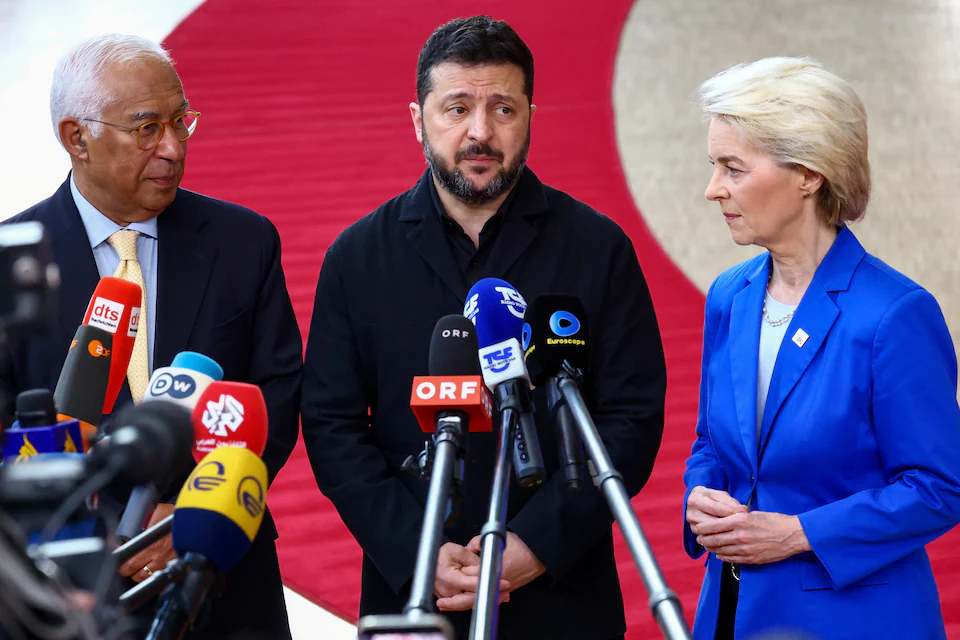
The diplomatic tensions intensified on Friday as Zelenskyy attended a European leaders’ summit in Brussels, seeking continued financial assistance, air defence equipment and energy support ahead of winter.
The meeting comes at a critical moment for Ukraine, which is struggling to protect its cities and electricity infrastructure from Russian missile and drone attacks while uncertainty grows over the future of American military and intelligence assistance.
Trump has criticised Ukraine’s recent attacks on Russian oil refineries, arguing that they are contributing to higher global energy prices. European leaders, however, have emphasised the need to sustain support for Kyiv as its war against Russia continues.
TRUMP CRITICISES UKRAINE’S OIL REFINERY ATTACKS
Trump condemned Ukraine’s latest strike on a Russian oil refinery, describing the operation as a “disgrace” during an interview with the American news outlet Newsmax.
The attack followed Zelenskyy’s announcement that Ukraine would resume strikes against Russian energy infrastructure after a proposed pause in such operations broke down.
Trump had announced the previous weekend that Russia and Ukraine had agreed not to target each other’s energy facilities. However, the scope and terms of the proposed arrangement remained disputed, with the two sides presenting conflicting accounts of the situation.
Ukraine subsequently attacked a refinery in Russia’s Ryazan region, southeast of Moscow. The facility helps supply fuel to the Russian capital and is part of the country’s wider oil-processing infrastructure.
Trump argued that Ukrainian attacks on Russian refineries were pushing energy prices higher. His criticism comes as his administration faces domestic political pressure over energy costs ahead of the United States’ November midterm elections.
The dispute has exposed differences between Washington and Kyiv over how military pressure should be used to influence Moscow and bring the war to an end.
ZELENSKYY SEEKS URGENT SUPPORT FOR WINTER
Addressing the European summit, Zelenskyy said Ukraine wanted to end the war as quickly as possible but had seen no clear indication that Russia was ready to stop fighting.
He stressed that preparations for winter must extend beyond energy supplies to include air defence systems and financial assistance.
“The winter package is not only energy, it’s also air defence and funding,” Zelenskyy said as he arrived for the meeting.
Ukraine’s electricity infrastructure has repeatedly come under attack during the war, raising concerns about the impact of further strikes as temperatures fall.
Recent Russian attacks have caused power disruptions in several parts of the country. In the Volyn region, which borders Poland, strikes reportedly left approximately 370,000 people without electricity. Emergency power cuts were also introduced in Kyiv.
In Kharkiv, Russian drone strikes killed three people, according to local authorities.
The attacks have increased the urgency of Ukraine’s requests for equipment to intercept incoming missiles and drones, alongside financial assistance to maintain essential public services and military operations.
UKRAINE FACES BILLIONS OF DOLLARS IN FUNDING NEEDS
Ukraine’s financial requirements are another major issue confronting European leaders.
Ukrainian Finance Minister Sergii Marchenko has said the country faces an unfunded budget gap of $32.6 billion for 2027. That figure does not include an estimated additional $40 billion needed in direct military supplies from international partners.
The funding challenge comes as Kyiv attempts to sustain its armed forces, purchase military equipment and keep government services operating despite the economic pressure created by the war.
Zelenskyy previously said Ukraine had reached an arrangement with European partners aimed at addressing a $27 billion shortfall in military spending for 2026. The plan was intended to help the country order the drones it needs to continue fighting into early 2027.
However, commitments for future assistance remain a concern.
Dutch Prime Minister Rob Jetten said he was dissatisfied with the number of countries prepared to announce new financial support for Ukraine, although he expected additional military commitments from some governments.
Jetten also said the discussions with Zelenskyy would focus on the difficult diplomatic situation and how Ukraine could withstand the coming winter.
Belgian Prime Minister Bart De Wever highlighted the scale of the financial challenge, questioning whether European countries would continue providing the resources needed to keep Ukraine’s government and military functioning.
His remarks reflected the broader question facing the bloc: whether European governments can maintain sufficient political and financial unity to support Ukraine if American assistance becomes less dependable.
DISAGREEMENT OVER RUSSIAN OIL AND DIESEL
Energy policy has added another layer of tension to the diplomatic dispute.
Trump has linked his criticism of Ukrainian refinery strikes to rising energy prices, while his administration is also considering easing sanctions on some vessels associated with Russia’s so-called shadow fleet, which transports oil and petroleum products.
The possible easing of restrictions has raised concerns among Ukraine’s supporters because oil revenues are an important source of income for Russia.
European leaders have also criticised a deal involving Russian diesel, amid wider disagreement over how to manage energy costs while maintaining economic pressure on Moscow.
The debate has become more complicated because energy prices have risen following the war involving Iran, exposing differences among European Union members over how to respond to the economic consequences.
For Ukraine, allowing Russia to earn additional revenue from oil exports could undermine efforts to limit Moscow’s ability to finance its military campaign.
Russia, meanwhile, has played down the impact of Ukrainian attacks on its refineries. President Vladimir Putin said the strikes had caused nothing particularly significant, despite Kyiv’s efforts to target facilities linked to Russia’s energy sector.
RUSSIA TAKES CONTROL OF EUROPEAN COMPANIES’ ASSETS
Tensions between Moscow and European governments have also extended into the business sector.
Ahead of Zelenskyy’s appearance at the Brussels summit, Russia moved to place local assets belonging to French, German, Swedish and Dutch companies under temporary management.
The move was presented as retaliation amid European support for Ukraine.
The development adds to concerns among European businesses operating in Russia and highlights the growing economic consequences of the conflict beyond the battlefield.
European governments must now balance continued assistance to Kyiv with the risks of further retaliation, economic disruption and higher energy costs.
EUROPE’S ROLE BECOMES MORE IMPORTANT
The Brussels meeting could help determine how European governments respond if American support for Ukraine becomes more uncertain.
Zelenskyy is seeking assurances that European partners will continue providing military equipment, financial assistance and energy support as Russia maintains its attacks.
Trump’s criticism of Ukraine’s refinery strikes has complicated the diplomatic environment, particularly because Kyiv depends on Western countries for vital military capabilities.
European leaders have continued to express support for Ukraine, but questions remain over how quickly additional resources can be mobilised and whether individual governments will commit enough funding to cover the country’s growing needs.
The coming winter is expected to place further pressure on Ukraine’s energy system and public finances, making decisions taken at the summit particularly important.
For Kyiv, the immediate priority is to secure enough support to protect its population, maintain electricity supplies and sustain military operations. For European governments, the challenge is to demonstrate that their backing can remain reliable despite disagreements over diplomacy, energy prices and the future direction of the war.
The outcome of the discussions will help indicate how far Europe is prepared to go in supporting Ukraine as the conflict continues and uncertainty grows over Washington’s position.