World News
DJIBOUTI BOAT DISASTER KILLS 139 MIGRANTS AS 84 REMAIN MISSING
At least 139 migrants, including 15 children, have died after an overcrowded boat capsized off the coast of Djibouti while carrying passengers towards...
By Wavers News
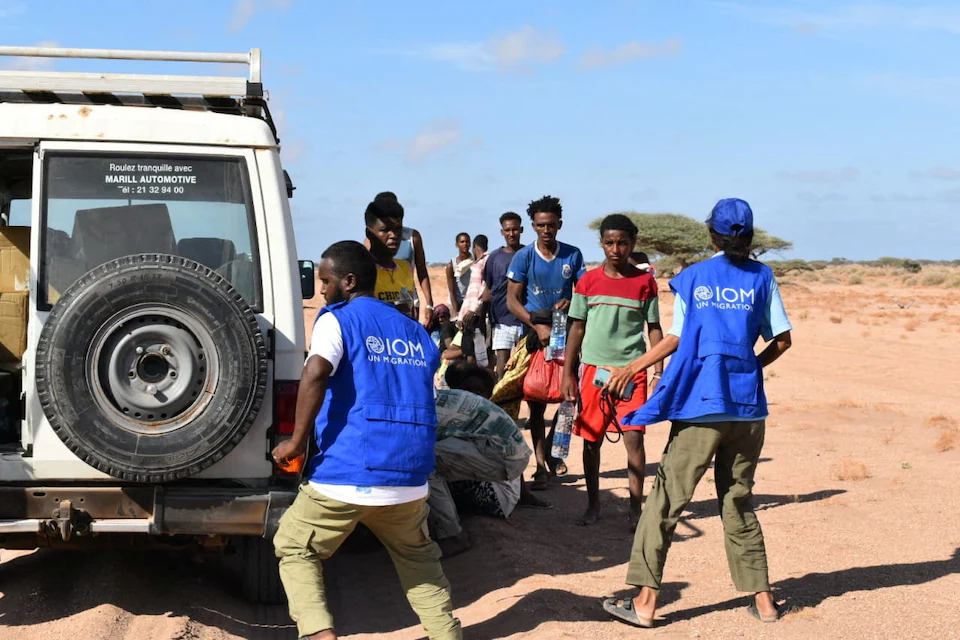
Migrants are received by International Organization for Migration workers following a deadly boat capsize near Guhere, north of Obock, Djibouti, on October 11, 2026. The vessel was carrying about 305 people from Djibouti towards Yemen, with at least 109 migrants, including 15 children, confirmed dead and more than 116 others missing.
The vessel was carrying 305 people when it overturned near Guhere, north of the port town of Obock, during the night of October 8 to 9. Eighty-two people survived the disaster, while 84 others remained missing as search and rescue operations continued on Sunday, October 11.
The tragedy has renewed concerns about the dangers facing migrants who cross the Gulf of Aden from the Horn of Africa in hopes of reaching employment opportunities in wealthier Gulf countries.
OVERCROWDED VESSEL CAPSIZES NEAR DJIBOUTI COAST
The boat capsized shortly after beginning its journey towards Yemen, according to accounts provided by survivors. The number of people aboard made the incident particularly devastating, with a large proportion of passengers either losing their lives or remaining unaccounted for.
The vessel went down near Guhere, an area north of Obock on Djibouti's eastern coast. The location lies along a migration corridor frequently used by people travelling between the Horn of Africa and the Arabian Peninsula.
The confirmed death toll reached 139, including 15 children. However, the final number of casualties could change as rescue teams continue searching for those who have not been found.
The 82 survivors have been accounted for, but the 84 people still missing have left relatives and communities waiting for information about their whereabouts.
The disaster also placed significant pressure on local emergency responders, who have been working to recover bodies, assist survivors and coordinate search operations along the coast.
RESCUE TEAMS PROVIDE EMERGENCY ASSISTANCE
Djiboutian authorities continued search and rescue operations following the shipwreck, while humanitarian personnel provided assistance to people who survived.
Emergency support has included medical care and other immediate needs arising from the disaster. Authorities have also been arranging burials for those who died.
The scale of the tragedy has created difficulties in identifying all the victims. Some bodies were buried by local authorities, while others were reportedly buried by fellow migrants before they could be formally identified and included in the official count.
This means the confirmed death toll may not represent the full number of people who died during the incident.
Photographs released after the shipwreck showed damaged sections of the vessel, along with worn footwear washed ashore. The images illustrated the aftermath of a journey that ended in a major humanitarian emergency.
For survivors, the immediate priorities include receiving medical attention and assistance after the traumatic experience. For families whose relatives remain missing, the continuing rescue operation offers the possibility of obtaining answers.
MIGRANTS WERE HOPING TO REACH WEALTHIER GULF COUNTRIES
Many of the passengers were believed to be Ethiopian migrants travelling through Djibouti in the hope of eventually reaching wealthier Gulf nations.
The journey through Yemen remains attractive to some migrants despite the serious risks involved, including the possibility of shipwreck, exploitation and detention.
People undertake the route for different reasons, including economic hardship, difficult living conditions and insecurity in their home communities. For some, the prospect of finding employment abroad appears to outweigh the dangers of travelling in overcrowded boats.
However, reaching Yemen does not necessarily mean the end of the journey. Migrants who survive the sea crossing may still face difficult conditions as they attempt to continue towards their intended destinations.
Yemen itself has experienced years of conflict and instability. Renewed fighting between government forces backed by Saudi Arabia and the Iran-aligned Houthi movement has further complicated the situation for people travelling through the country.
The latest disaster demonstrates how migrants can face serious danger even before reaching the country they hope to use as a gateway to employment elsewhere.
RENEWED FIGHTING ADDS TO PRESSURE ON ETHIOPIAN MIGRANTS
The shipwreck occurred as violence was escalating in parts of Ethiopia, particularly in the northern Tigray region.
Fighting that intensified in September has raised fears of a return to broader conflict following the devastating war fought between Ethiopian federal forces and Tigrayan forces from 2020 to 2022.
Residents of Tigray have reported that rebel forces were forcibly recruiting young men into their ranks. The rebels have denied carrying out forced recruitment.
Some Ethiopian migrants have also cited difficult living conditions and the effects of drought as reasons for leaving their communities.
These circumstances highlight the combination of economic, environmental and security pressures that can influence migration decisions. Although not every passenger aboard the boat necessarily left for the same reason, the wider situation helps explain why the route continues to attract people despite its dangers.
The renewed fighting has also raised concerns about regional stability, including relations between Ethiopia and neighbouring Eritrea.
For people already facing hardship, uncertainty and insecurity can make the search for opportunities elsewhere seem increasingly urgent, even when the available routes expose them to considerable risks.
EASTERN MIGRATION ROUTE CONTINUES TO CLAIM LIVES
The sea crossing between the Horn of Africa and Yemen is commonly known as the Eastern Route. It is used by migrants seeking to reach the Arabian Peninsula, particularly the Gulf states.
The route carries dangers beyond maritime accidents. Migrants may also encounter trafficking networks, exploitation and arbitrary detention after reaching land.
More than 900 migrants died or went missing along the route in 2025, while the number of people undertaking the journey increased by 18 per cent, figures from the International Organization for Migration's Missing Migrants Project show.
The continuing loss of life illustrates the risks faced by people who depend on irregular transport to cross the sea.
Overcrowding can make vessels particularly vulnerable to capsizing, while the lack of safe and reliable travel arrangements can leave passengers exposed to life-threatening emergencies.
The latest shipwreck adds to the mounting toll of migrants who have died while attempting to reach destinations where they hope to find work and improve their living conditions.
YEMEN'S CRISIS ALSO FORCES PEOPLE TO FLEE
While migrants from Ethiopia and other parts of the Horn of Africa travel towards Yemen, the country is also experiencing movement in the opposite direction as people flee the conflict.
Displacement inside Yemen has increased sharply amid renewed fighting. Humanitarian figures released in the week before the shipwreck put the number of displaced people at approximately 200,000, up from 76,000 in mid-September.
More than 3,700 people had also travelled by sea from Yemen to Djibouti by the week before the report.
These movements demonstrate the complexity of migration across the region. Some people enter Yemen in pursuit of employment opportunities elsewhere, while others leave because insecurity has made remaining there increasingly difficult.
The situation places additional demands on authorities and humanitarian organisations assisting people who arrive in Djibouti after dangerous journeys.
CALLS FOR SAFER MIGRATION OPTIONS
The disaster has again highlighted the need to address the risks associated with irregular migration and improve access to safer alternatives.
Search and rescue operations remain essential when vessels encounter difficulties, but preventing further tragedies also requires attention to the circumstances that lead people to undertake dangerous journeys.
Economic hardship, insecurity and the hope of finding work abroad continue to influence decisions to migrate. Without safer and more accessible options, people may continue to depend on overcrowded boats despite the possibility of losing their lives.
For now, authorities in Djibouti face the immediate task of continuing the search for the missing, assisting survivors and identifying those who died.
With 84 people still unaccounted for in the latest reported figures, the disaster remains an unfolding humanitarian tragedy.