World News
CAMEROON FACES GROWING FEMICIDE CRISIS AS PROTESTS INTENSIFY OVER WOMEN’S SAFETY
YAOUNDE, CAMEROON — Growing concern over the killing of women in Cameroon has triggered protests and renewed demands for stronger legal protections, a...
By Wavers News
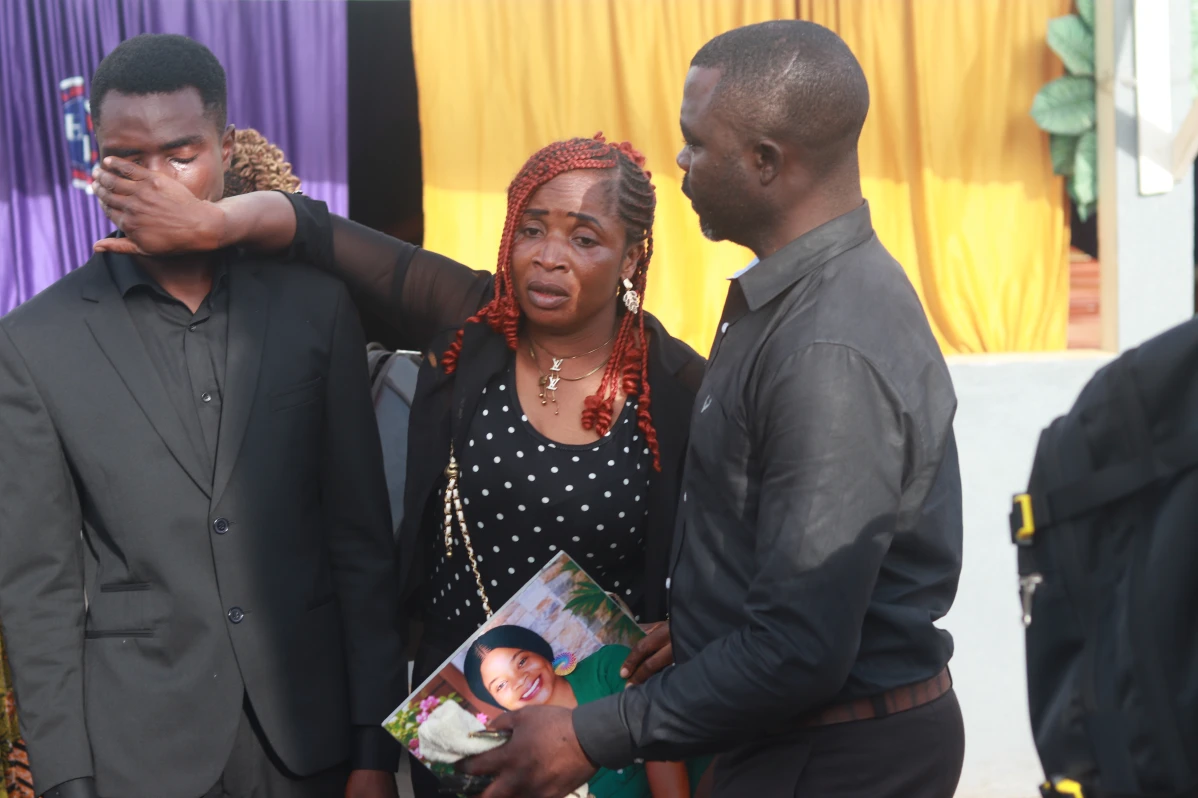
“Anushuni Courage Abombi, 18-year-old son of murdered Achiah Geraldine, is comforted by relatives outside a mortuary chapel in Yaoundé, Cameroon, on September 18, 2026.” PHOTO CREDIT: Angel Ngwe/AP Photo.
The crisis has drawn national attention following the death of Geraldine Achiah, an elementary schoolteacher in her 30s who died in September, barely two months after her marriage. Her relatives allege that she was fatally beaten by her husband during a marital dispute.
Her death has become a rallying point for people demanding accountability and changes to laws that currently do not explicitly recognise femicide as a separate criminal offence.
According to figures from Cameroon’s Ministry of Women’s Affairs cited in recent reporting, nearly 70 women were killed in gender-related killings during 2026. The figure represents an increase from government estimates of at least 50 cases in 2023 and 67 in 2024.
The growing toll has raised questions about the effectiveness of existing protections, the handling of domestic violence cases and the difficulties victims face when seeking assistance.
Authorities are working on proposed legislation that would establish femicide as a distinct criminal offence and strengthen broader protections against gender-based violence. The proposed bill is expected to be presented to parliament for consideration in November.
However, activists say that legislation alone will not be enough without effective investigations, adequate support services and a justice system capable of holding perpetrators accountable.
DEATH OF TEACHER BECOMES SYMBOL OF NATIONAL OUTRAGE
Achiah’s death has brought renewed attention to the risks faced by women experiencing violence within their relationships.
The elementary schoolteacher had married in July and died in September. Her relatives allege that her husband beat her during a marital dispute, leading to her death.
Her husband, Manfred Amambua, has denied killing her, according to police. He has been charged with murder and is being held in custody while awaiting trial. The allegations against him have not yet been determined by a court.
Hospital records documented several bruises on Achiah’s face and lips before her death. An officer involved in the investigation, Ndzana Bienvenu, said investigators had also collected phone footage showing Achiah and her husband after the alleged beating, alongside a blood-stained bedsheet.
The evidence forms part of the investigation into the circumstances surrounding her death.
Achiah’s family is seeking justice while also calling attention to other women whose deaths have raised concerns about domestic violence and the treatment of victims.
Her 18-year-old son, Courage Abombi, has spoken about the loss of his mother, who supported his ambition to become a mechanical engineer. He sat for a university entrance examination just one day after her burial.
Abombi has appealed for the legal process to proceed and for those responsible for his mother’s death to face justice.
For the family, the case represents both a personal tragedy and a wider concern about whether women experiencing violence can obtain meaningful protection.
NEARLY 70 GENDER-RELATED KILLINGS REPORTED IN 2026
The number of reported femicide cases in Cameroon has increased in recent years, according to government figures cited in reporting on the crisis.
The Ministry of Women’s Affairs has reported nearly 70 gender-related killings during 2026, compared with at least 50 cases in 2023 and 67 in 2024.
The figures have intensified demands for a stronger national response, particularly as campaigners warn that some killings remain unresolved and others may never be reported.
Femicide refers to the killing of women and girls for reasons connected to their gender. Such killings can occur in domestic relationships and other circumstances in which gender-related violence plays a role.
Activists in Cameroon have linked the problem to several factors, including economic dependence, unequal control over family property, gender inequality and inadequate access to protection.
Financial hardship can make it difficult for women to leave abusive relationships, particularly when they have children or lack independent income. Some may remain in dangerous circumstances because they have nowhere else to live or fear the consequences of reporting their partners.
Social stigma can create additional barriers, discouraging survivors from seeking help or making it harder for them to rebuild their lives after leaving abusive situations.
The problem also extends beyond individual households. Campaigners argue that weak enforcement, limited support services and delays in judicial proceedings can leave victims and their families without timely protection or justice.
Cameroon’s Women’s Affairs Minister, Marie-Thérèse Abena Ondoa, has described the reported cases as alarming and pledged further government action.
GAPS IN EXISTING LAWS FUEL CALLS FOR REFORM
One of the central demands from campaigners is the introduction of legislation that explicitly addresses femicide.
Cameroon’s Penal Code contains provisions covering crimes such as rape, murder and other forms of violence. However, it does not specifically establish femicide as a separate criminal offence.
Cases involving the killing of women are therefore handled under broader criminal provisions rather than a distinct legal framework specifically identifying gender-related killings.
Rights advocates argue that a dedicated offence could help strengthen recognition of the gender-related nature of these crimes and improve the way authorities respond to them.
The government is preparing a bill intended to establish femicide as a standalone criminal offence while also strengthening wider protections against gender-based violence. The legislation is expected to be submitted to parliament for consideration in November.
The proposed reform comes amid growing pressure on authorities to demonstrate that commitments to protect women will translate into effective action.
Human rights organisations have previously criticised the government’s response to gender-based violence, arguing that policy commitments have not been matched by sufficiently strong prevention measures, survivor support and accountability.
A new law would represent a significant policy development, but its impact would depend on how it is implemented.
Police officers would need to investigate cases effectively, prosecutors would need to present evidence properly, and courts would need to ensure that proceedings are conducted fairly and without unnecessary delays.
Campaigners also want stronger safeguards for women who report abuse, including protection against intimidation and access to services that can help them leave unsafe environments.
JUSTICE DELAYS AND WEAK ACCOUNTABILITY UNDER SCRUTINY
Beyond the absence of a specific femicide offence, activists have raised concerns about the wider functioning of the justice system.
Cases involving violence against women can be affected by delays, intimidation, corruption allegations and procedural problems. Such obstacles can undermine investigations and make it harder for families to obtain answers.
Carole Grace Mbarga, a Cameroonian rights activist based in the United States, has warned that prolonged investigations can weaken cases by allowing evidence to deteriorate and reducing witnesses’ confidence in the process.
When proceedings take too long, relatives may become discouraged, while witnesses can lose confidence that their participation will lead to a meaningful outcome.
Campaigners also argue that penalties imposed in some cases have failed to meet public expectations for accountability.
In one case from 2025 cited in reporting on the issue, a man who pleaded guilty to killing his wife received a suspended five-year sentence and a fine of 52,000 CFA francs, equivalent to approximately US$90 at the time.
The case has been highlighted amid broader concerns about whether punishments in some domestic violence cases adequately reflect the seriousness of the harm caused.
However, each criminal case depends on its own evidence and legal circumstances. Reform advocates say the wider priority should be ensuring that investigations are thorough, proceedings are fair and decisions are consistent with the law.
They argue that justice must include both accountability for offenders and effective protection for people at risk.
PROTESTS IN YAOUNDE AND DOUALA DEMAND ACTION
The reported increase in killings has prompted demonstrations in major Cameroonian cities, including Yaounde and Douala.
Thousands of demonstrators have called for stronger protections, effective investigations and action from authorities to prevent further deaths.
The protests have brought together activists, relatives of victims and members of the public who believe existing responses have failed to provide adequate protection for women experiencing violence.
Demonstrators have called for a dedicated femicide law, but their demands extend beyond criminal legislation.
Campaigners also want improved access to emergency assistance, better support for survivors, more effective enforcement of existing laws and measures to address the social and economic circumstances that can leave women trapped in abusive relationships.
Laura Sen, one of the protest organisers, has stressed the need to address systemic barriers alongside the proposed legal reforms.
For activists, the objective is not simply to increase penalties after a killing has occurred. It is also to prevent violence before it becomes fatal.
This includes making it easier for victims to report abuse, ensuring that authorities respond appropriately to complaints and providing safe accommodation for women who cannot remain in their homes.
The demonstrations have helped place the issue more prominently in public discussion and increased pressure on the government to explain how it intends to respond.
ECONOMIC DEPENDENCE AND LACK OF SAFE HOUSING COMPLICATE ESCAPE FROM ABUSE
Activists say financial insecurity is a major obstacle for women attempting to leave violent relationships.
Women who depend on their partners for housing, food or other essential expenses may face difficult choices when abuse occurs. Leaving can mean losing access to accommodation or the resources needed to support themselves and their children.
For some survivors, the absence of a safe place to stay can make the immediate risks of leaving appear as serious as the risks of remaining in the relationship.
Campaigners argue that advising women to leave abusive partners is insufficient unless practical support is available.
Emergency shelters, counselling, legal assistance and access to independent financial resources can help survivors make decisions about their safety without being forced back into dangerous circumstances.
Social pressure and stigma can also discourage women from seeking assistance. In communities where domestic problems are treated as private family matters, survivors may fear being blamed for exposing abuse or ending a relationship.
These pressures can make it harder for victims to report violence early, before it escalates.
Rights advocates therefore want the government’s proposed response to include prevention programmes and adequately funded services, rather than relying exclusively on criminal penalties.
They also argue that public awareness efforts should challenge attitudes that normalise violence or discourage women from seeking protection.
CAMEROON’S RESPONSE FACES A CRITICAL TEST
The government’s proposed legislation is expected to be considered by parliament in November, placing the coming weeks at the centre of efforts to address the crisis.
If adopted, a dedicated femicide offence could establish a clearer legal framework for dealing with gender-related killings. The legislation is also intended to strengthen broader protections against gender-based violence.
However, the scale of the challenge means that legal reform would need to be accompanied by effective implementation.
Authorities would need to ensure that reports of violence are taken seriously, investigations are conducted properly and victims can access assistance before situations escalate.
Funding will also matter. Shelters and support services require trained personnel, secure facilities and resources to help women and children facing immediate danger.
Campaigners say better coordination among police, courts, social services and government agencies would be essential to achieving lasting results.
The reported killings have also raised wider questions about women’s safety, economic independence and equal access to justice in Cameroon.
For families who have lost loved ones, the immediate priority remains accountability. For activists, the broader goal is to prevent other families from experiencing similar losses.
The death of Geraldine Achiah has become a focal point for those demands, but campaigners insist that the response must extend to every case in which women are killed or exposed to serious violence.
As the proposed bill moves towards parliamentary consideration, the government faces pressure to demonstrate that its commitments will lead to meaningful protection, stronger accountability and practical support for women at risk.