International
ALBERTA SEPARATIST MOVEMENT FACES PUBLIC SUPPORT CHALLENGE AHEAD OF REFERENDUM
CALGARY, CANADA — Campaigners advocating Alberta’s separation from Canada are facing questions about their level of public support, political organisa...
By Wavers News
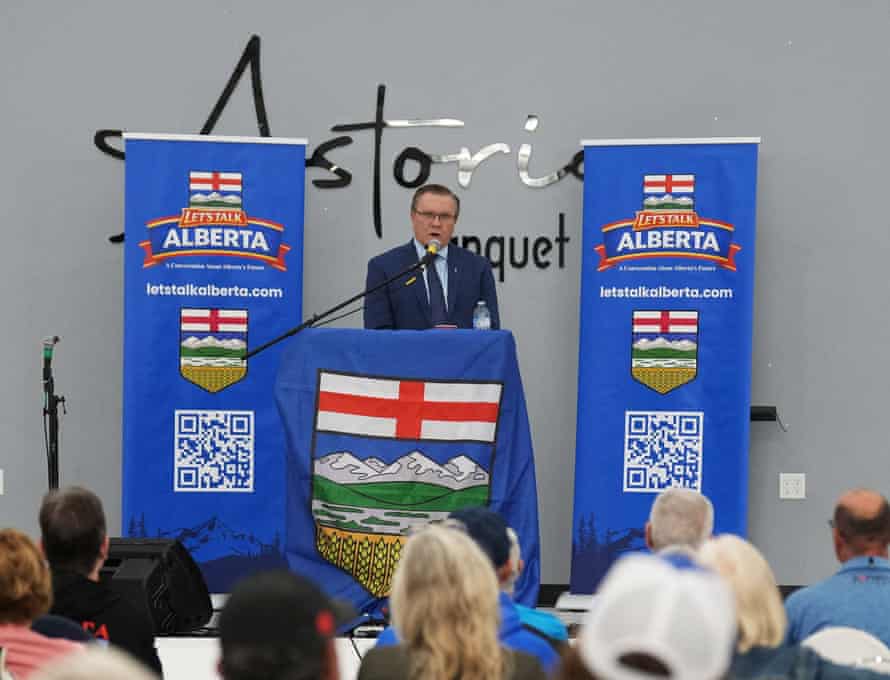
Alberta independence advocate Keith Wilson addresses supporters during a Let’s Talk Alberta meeting in Calgary on October 13.
The debate intensified during a conference organised by the WeUnify movement in Calgary, where separatist activists gathered to promote their vision of an independent Alberta and criticise the federal government’s influence over the province.
Despite the determination displayed by participants, the movement faces a significant challenge in persuading the wider population to support its objectives. A poll cited in recent reporting put public support for independence at just 14 per cent, illustrating the gap between the enthusiasm of committed campaigners and opinion across the province.
The conference brought together conservative activists, veterans of the pandemic-era freedom movement and supporters who believe Alberta should have greater control over its natural resources, economic policies and political future.
However, divisions over strategy, leadership and the practical implications of separation continue to complicate the campaign.
SEPARATISTS RALLY SUPPORT FOR AN INDEPENDENT ALBERTA
The Calgary gathering provided a platform for supporters to present their arguments for ending Alberta’s status as a Canadian province.
Participants expressed frustration with the federal government, particularly over policies they believe have restricted the province’s ability to develop its oil and gas industries and benefit fully from its natural resources.
Alberta possesses substantial energy resources, making control over oil revenues and related economic decisions central to the independence debate.
Conservative activist and broadcaster Faytene Grasseschi addressed conference attendees, arguing that Alberta’s resources had been taken out of the province’s control. Her remarks drew applause from an audience that included people convinced that independence would offer a better economic and political future.
Chris Scott, founder of the Let's Talk Alberta group, also urged supporters to continue their campaign. His organisation promotes arguments for separation and has produced publications setting out reasons why Alberta should leave Canada.
Scott became widely known during the COVID-19 pandemic after being arrested for violating public health restrictions. Following a lengthy legal battle, he was acquitted.
Supporters at the conference described the independence movement as a response to what they perceive as an entrenched political establishment that does not adequately represent Alberta’s interests.
For many, the campaign is about more than constitutional change. It reflects longstanding disagreements over energy policy, government authority and the relationship between western Canada and Ottawa.
Nevertheless, gaining the support of people who are not already committed to independence remains one of the movement’s most difficult tasks.
OCTOBER 19 REFERENDUM WILL DETERMINE WHETHER THE PROCESS SHOULD ADVANCE
Alberta is scheduled to hold a referendum on October 19, 2026, asking voters whether the province should remain part of Canada or whether the provincial government should begin the legal process required to hold a future binding referendum on separation.
The distinction is important: the October 19 vote will not itself make Alberta independent.
The question asks voters to choose between remaining a Canadian province and allowing the provincial government to commence the legal process necessary for a subsequent binding vote on separation.
The referendum is non-binding. Even if a majority supports moving towards a future separation referendum, independence would require further legal and constitutional steps.
Those steps could involve negotiations with the Canadian federal government and other provinces, alongside questions about the rights and interests of Indigenous peoples and existing treaties.
The issue has also faced legal complications involving Indigenous groups, whose rights and constitutional protections could be affected by a potential separation process.
For separatist campaigners, the upcoming vote represents an opportunity to demonstrate that their movement has sufficient public backing to advance its political ambitions.
For opponents, it raises concerns about the consequences of reopening a fundamental question about Canada’s territorial integrity.
The referendum is part of a wider ballot containing questions on other provincial issues, including immigration, eligibility for publicly funded services and voter identification.
PUBLIC SUPPORT REMAINS A MAJOR OBSTACLE
Despite the energy displayed at separatist gatherings, available polling suggests that independence remains a minority position among Alberta residents.
The 14 per cent figure cited in reporting on the Calgary conference highlights the difficulty campaigners face in converting strong convictions among their supporters into broader electoral backing.
The referendum debate has also exposed differences among residents who want greater provincial autonomy but do not necessarily support leaving Canada.
Some Albertans favour changes to federal policies on energy, taxation and resource development while preferring to remain within the Canadian federation.
Others view the prospect of a separation referendum as a way to pressure Ottawa into addressing provincial grievances, rather than as a commitment to establishing an independent country.
These distinctions matter because opposition to federal policies does not automatically translate into support for independence.
Alberta Premier Danielle Smith has acknowledged the province’s grievances with the federal government but opposes separation. The referendum therefore takes place amid disagreement not only between separatists and federalists but also among people who share concerns about Alberta’s position within Canada.
For the independence movement, the immediate challenge is to convince voters that separation would offer practical benefits that outweigh the risks and uncertainties.
ECONOMIC COSTS RAISE QUESTIONS ABOUT INDEPENDENCE
The potential financial consequences of separation have become central to the debate.
A report prepared by the University of Calgary’s School of Public Policy examined possible economic and fiscal outcomes under two hypothetical scenarios: one involving relatively smooth negotiations with Canada and another involving a more difficult transition.
The research estimated that establishing an independent Alberta could cost between C$50 billion and C$170 billion during the first five years following separation.
The figures are scenario-based estimates, not a prediction that Alberta will necessarily incur one particular amount. The actual outcome would depend on negotiations, policy decisions and how responsibilities currently managed by the federal government were transferred or recreated.
The report examined issues including the cost of establishing government institutions, taking responsibility for federal services, acquiring infrastructure and determining Alberta’s share of national debt.
An independent province would also need to address arrangements for taxation, trade, currency, public administration and its international relationships.
The research identified the possibility of substantial annual budget deficits under difficult circumstances, although the scale of any deficit would depend on the transition arrangements and future economic conditions.
For separatists, Alberta’s energy wealth is a central argument in favour of independence. They believe the province could use its resources to make decisions more directly in the interests of its residents.
However, resource wealth alone would not eliminate the costs of creating a new country or resolve questions about how existing federal responsibilities would be funded.
The economic debate therefore remains one of the most consequential aspects of the independence campaign.
LEADERSHIP AND ORGANISATION REMAIN WEAKNESSES
The separatist movement has also struggled to develop a unified political structure capable of turning its campaign into a sustained electoral force.
Unlike Quebec, where political parties have previously campaigned explicitly for independence and secured substantial electoral support, Alberta’s separatist movement lacks an established party with broad representation in the provincial legislature.
No elected officials have publicly campaigned for independence as part of the movement described at the Calgary conference.
The campaign has instead relied on activists, community organisers and individuals promoting their own arguments about the province’s future.
Keith Wilson, a lawyer involved in developing the movement’s legal and political proposals, has been among the figures seeking to outline how Alberta could transition from a province into an independent country.
In September, Wilson and other contributors published the Alberta Transition Plan, a 214-page document setting out a proposed framework for that transition.
However, the plan has faced criticism over unanswered questions about the costs and practical requirements of establishing an independent state.
Wilson also expressed reservations about the conference itself, describing it as an echo chamber in which participants were largely speaking to people who already agreed with them rather than persuading undecided voters.
His criticism reflects a wider challenge for the movement: generating enthusiasm among supporters is not the same as building a convincing political programme for the broader electorate.
The absence of a single recognised leader has also contributed to differences over strategy and messaging.
Some campaigners believe the movement should remain grassroots, while others argue that a more coordinated approach is necessary to gain public credibility.
CONTROVERSIES ADD TO THE MOVEMENT’S CHALLENGES
The conference also highlighted the range of political backgrounds represented within the separatist movement.
Some participants became involved through opposition to COVID-19 restrictions, while others have focused on longstanding disagreements over federal energy policy and provincial autonomy.
Although these groups share distrust of established institutions, their views on how an independent Alberta should operate are not necessarily identical.
Controversies surrounding prominent individuals associated with the wider movement have also attracted scrutiny.
The movement’s critics argue that the absence of clear leadership and a unified political structure makes it difficult to assess who speaks for the campaign and how its proposals would be implemented.
Some campaigners, however, regard their decentralised structure as a strength, arguing that independence should be driven by ordinary residents rather than established political figures.
The disagreement illustrates the tension between grassroots mobilisation and the need for a credible, detailed plan for governing a new country.
For voters considering the referendum, the questions extend beyond whether Alberta should have greater control over its affairs. They also concern who would lead a transition, how decisions would be made and whether the proposed arrangements could deliver the benefits promised by supporters.
ALBERTANS REMAIN DIVIDED OVER THE PROVINCE’S FUTURE
Opposition to independence remains visible among residents who believe separation would bring more risks than benefits.
Some longtime Calgary residents have expressed concern that leaving Canada could damage communities, create economic uncertainty and weaken relationships built across provincial boundaries.
For these residents, Alberta’s disagreements with Ottawa should be addressed through political negotiations and reforms within Canada rather than through the creation of a separate country.
Other residents support greater provincial autonomy but are concerned about the practical consequences of separation, including the costs of establishing new institutions and negotiating future trade and financial arrangements.
Within the separatist movement, some supporters see the referendum as a historic opportunity to advance independence, while others view it as a way to increase pressure on federal leaders.
The movement’s ability to unite these different motivations could influence its performance at the ballot box.
A vote against proceeding would represent a setback for those seeking a future binding referendum, although some campaigners have said they intend to continue organising regardless of the outcome.
A vote in favour would advance the political process but would not settle the question of independence itself.
REFERENDUM COULD SHAPE CANADA’S FEDERAL RELATIONSHIP
The October 19 referendum is likely to have implications for relations between Alberta and the federal government, regardless of the outcome.
A strong showing for the separatist option could increase pressure on federal and provincial leaders to address concerns about energy policy, resource revenues and the division of powers within Canada.
A rejection of the proposal could strengthen the position of those who favour resolving disagreements through existing political and constitutional arrangements.
The debate also raises broader questions about how a resource-rich province can balance demands for greater autonomy with the economic, legal and political relationships that come with membership in a federation.
For separatist campaigners, the immediate task is to demonstrate that their vision has support beyond a committed minority. They must also explain how Alberta would manage the financial, institutional and constitutional challenges that independence would create.
For opponents, the challenge is to address provincial grievances while making the case that Alberta’s interests can be protected within Canada.
The referendum will provide an important indication of public opinion, but it will not by itself determine Alberta’s long-term constitutional future.